COPH Faculty Receive 2016 Distinguished Faculty Awards
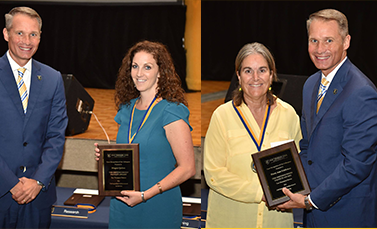
JOHNSON CITY (Aug. 19, 2016) – East Tennessee State University bestowed its highest honors upon three professors on Friday, Aug. 19, with the presentation of the 2016 Distinguished Faculty Awards for Teaching, Research and Service.
The winners were nominated and selected by their faculty peers. Each received a medallion, a plaque and a $5,000 check provided by the ETSU Foundation during the annual Faculty Convocation, which marks the beginning of the new academic year and fall semester.
The Distinguished Faculty Award in Teaching was presented to Dr. Mary Ann Littleton, an associate professor in the College of Public Health’s Department of Community and Behavioral Health. (Interview with Dr. Littleton)
Littleton is locally and nationally known as a leader in community-based teaching and learning and interprofessional education. She designed “Trilogy: An Innovative Course Sequence for Training Community Health Professionals,” an award-winning series of three courses in which student teams assess community health needs, design a community-based intervention program or policy to address those needs, and then implement and evaluate that intervention with community input.
Littleton was one of the primary faculty members involved in ETSU’s Interprofessional Rural Track program, a collaborative initiative of the colleges in ETSU’s Academic Health Sciences Center that was funded by the Kellogg Foundation. Through this program, teams comprised of students in public health, nursing, medicine and related fields learned and worked together while affecting change in rural Appalachian communities.
Littleton also led the design and implementation of ETSU’s online Master of Public Health in Community Health degree program, which offers courses completely online and allows working professionals, parents and other non-traditional students to complete a rigorous program of study in this field. In addition, she has guided over 100 projects through community-based learning courses at the master’s and doctoral levels.
“For 15 years, (Littleton) has worked tirelessly to design and deliver unparalleled educational experiences for ETSU students, while affecting change in communities across Appalachia and the nation,” her nomination states. “While the effectiveness of community-based instruction is exceptionally high, many faculty shy away from this … approach, because it can be very time-consuming and challenging. Developing and nurturing relationships with the community and gaining the trust of community partners are no easy tasks…. (She) is fully aware of those challenges, yet she embraces community-based teaching because it is the ‘right thing’ to do. No other educational strategy allows her students to effectively learn while simultaneously empowering communities to improve their health and well-being.”
Littleton’s students praise her for her enthusiasm, patience, encouragement and understanding, as well as for the effectiveness of her teaching method.
Littleton holds a B.A. degree in psychobiology from the University of California at Santa Cruz and underwent secondary science teacher training in Sierra Leone, West Africa, through the U.S. Peace Corps. She earned her Ph.D. in health education and promotion at the University of Alabama-Birmingham, where she taught and served as a research coordinator for Community Health Advisor Programs before joining the ETSU faculty in 2002. In addition to her academic career, Littleton has worked as a licensed massage therapist and has 25 years of training and practice in various healing art techniques, including meditation, yoga, qigong and t’ai chi.
Dr. Megan Quinn is the recipient of the Distinguished Faculty Award for Service. (Interview with Dr. Quinn)
She is an assistant professor in the Department of Biostatistics and Epidemiology within the College of Public Health.
In receiving the award, Quinn was recognized for her exceptional service contributions to the community, public health profession and the university, particularly her dedication to underserved communities, both locally and globally, and her commitment to public health workforce development.
From Haiti and Nicaragua, the poorest countries in the western hemisphere, to Rwanda on the African continent, Quinn has contributed her public health knowledge and skills to help improve the health of impoverished children and adults who are victimized by disasters and suffer the consequences of poverty and injustice on a daily basis.
In Nicaragua, she has partnered with the Center for Development in Central America to assist local communities in implementing health programs, and has organized study abroad trips for ETSU students to carry out those life-saving projects. In Haiti, she has provided health education and delivered hygiene supplies to orphaned children impacted by the 2010 earthquake. And in Rwanda, she has focused on improving water quality and installing biosand water filters to provide clean water for residents while also providing health education, mosquito nets and other necessities to hundreds of people.
“It is quite amazing that Dr. Quinn has successfully reached out, partnered with, and gained the trust of communities around the globe,” her nominators wrote. “Beyond the technical epidemiological skills, such service requires exceptional altruism, professionalism, communication skills and cultural competency.”
In addition to her global service, Quinn serves her local community as a member of the board of directors of the Girl Scout Council of the Southern Appalachians, which serves about 9,500 girls in 46 counties across the region, and as a middle school girls’ soccer coach. Here, also, her focus remains on serving disadvantaged groups, in this case, on empowering young girls to break the chain of poverty by offering opportunities to realize their self-worth and achieve their potential.
Quinn also helps organize and deliver public health workforce training activities, partnering with the Sullivan County Health Department to provide simulation exercises to practicing public health workers and has partnered with the Tennessee Department of Health to offer continuing education to its workforce.
Her service activities also extend to ETSU, where she is an active member of the institution’s International Advisory Council, International Education Scholarship Committee, Study Abroad Committee and International Friendship Program. She serves as the ETSU chapter advisor for Timmy Global Health, guiding the student organization on global health matters and health trips.
“Megan serves because she believes that every individual, regardless of social status and origin, has the right to a healthy, productive and fulfilling life,” her nominators wrote. “She pursues this belief by challenging the status quo, creatively crafting opportunities to impact the most disadvantaged communities and pouring her heart into everything that she does.”
Quinn received a bachelor of arts degree in psychology from Wesleyan College in Macon, Georgia. She received her master’s degree in public health research from the University of Edinburgh in the U.K. and her Ph.D. in epidemiology from ETSU.