December 2015 - CPH faculty member visits nation's capital to talk rural public health with policy advisors
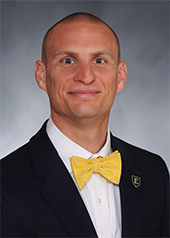
Dr. Nathan Hale, an assistant professor in East Tennessee State University’s College of Public Health, recently returned from a visit to the nation’s capital where he met with leaders to discuss challenges surrounding rural public health.
“We don’t have a good handle from a systems-level perspective about what’s going on in rural public health. All the focus is on larger, urban areas,” Hale said. “There’s a big difference between people living in rural areas and people in urban areas.”
Studies show there is a lower life expectancy for those who live in rural areas compared to those living in urban areas.
“When you step back and look at the factors driving the difference, they are things like unintentional injury, cardiovascular disease and smoking-related diseases,” Hale said, pointing out that these three factors alone account for 70 percent of the difference in the rural-urban gap.
Born and raised in Southeastern Kentucky, Hale has spent much of his career addressing the disparities in rural areas compared to urban areas. He spent the last six months working to create a document that looks at existing literature to assess what is already known about issues related to rural public health.
That document, “Rural Public Health Systems: Challenges and Opportunities for Improving Population Health,” was the basis for Hale’s recent conversations with policy advisors for several elected officials, including Senators Lamar Alexander (R-Tenn.), Al Franken (D-Minn.), Patty Murray (D-Wash.) and Pat Roberts (R-Kansas).
Hale was invited by AcademyHealth, a national organization serving the fields of health service and policy research and the professionals who produce the work, to present the educational information alongside fellow subject matter expert Michael Meit, co-director of the NORC Walsh Center for Rural Health Analysis in Bethesda, Maryland.
“What we know is that there’s not been much of a focus on rural health nationally,” Hale said. “Given that 20 percent of the population lives in rural communities and there’s obvious differences in how long they live and their health in general, perhaps some more targeted public health initiatives would be justified.”
While Hale said there are some programs that might work well in the short-term to bridge the gap between urban and rural public health, “ultimately, part of the reason you see these differences are the antecedents more prevalent in rural communities – things like unemployment and a lack of education.
“At the end of the day, developing rural economies in a way that provides our friends and neighbors with good jobs and a solid educational foundation is really the most important thing we can do for rural communities, which is also the most challenging. You have to address employment and education along with health—they are all inter-related.”
Hale, who joined ETSU’s Department of Health Services Management and Policy in August, came to East Tennessee most recently from the University of South Carolina where he worked for five years at the South Carolina Rural Health Research Center. It is one of just seven such federally funded centers in the country. Prior to his time at USC, Hale worked in public health practice for eight years, including as an epidemiologist and director of rural public health departments in the Upper Cumberland region of Tennessee.
He will begin serving a two-year term on the AcademyHealth Public Health Systems Research Interest Group Advisory Committee next month. There, he will continue his work with addressing rural public health disparities. His work is featured in a segment on WJHL's Daytime Tri-Cities.