ETSU Health Faculty and Students Study Hepatitis C in Rural Appalachia
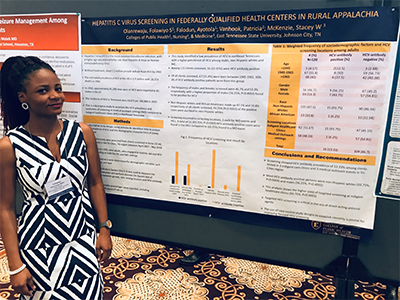
Folawiyo Olanrewaju, Master of Public Health student in East Tennessee State University’s College of Public Health, has authored an article in the Healthcare Research and Public Safety Journal. The article, “Hepatitis C Virus Screening In Federally Qualified Health Centers in Rural Appalachia,” is a descriptive study designed to ascertain the Hepatitis C Virus (HCV) prevalence and usefulness of screening in medical outreach settings compared to indigent healthcare clinics in northeast Tennessee. Ms. Olanrewaju recently presented the research at the Southern Regional Meeting of the Southern Society for Clinical Investigations in New Orleans, Louisiana.
Drs. Patricia Vanhook and Stacey McKenzie of the ETSU College of Nursing, along with College of Public Health students Falodun Ayotola, Anthony Peluso, Muhammed Jawla, and Enaholo Omoike are co-authors.
The Hepatitis C Virus (HCV) is a common blood borne infection, with a higher age-adjusted mortality rate than Hepatitis B Virus (HBV) or Human Immunodeficiency Virus (HIV). Recent estimates show that more than 185 million people are infected with HCV worldwide. The prevalence of HCV in the US is estimated at 2.7 to 3.9 cases per 100, 000 with 19 659 deaths in 2014. Without treatment, nearly 1.1 million people will die from HCV by 2060. About 34 000 new cases of Hepatitis C Virus were reported in 41 states in the US in 2015. The incidence of HCV in Tennessee was 13,023 per 100,000.
This descriptive study compares the observed outcome of routine HCV screening in medical outreach settings and indigent healthcare clinics in Northeast Tennessee. Between April 2017 and May 2018, routine, opt-out HCV testing was performed in 3 indigent health care clinics and 3 medical outreach sites in the Tri-Cities region of Tennessee. During screening, demographic information was collected and the de-identified data were analyzed.
A total of 120 persons were screened for HCV. Among these, 16 were HCV-antibody positive. Of all patients screened, 67 (55.8%) were born between 1945 and 1965. 50% of HCV-antibody positive patients were from this group. The frequency of males and females screened were 46.7% and 53.3% respectively, with a higher proportion of males found to be positive for HCV. Screening demonstrated HCV antibody prevalence of 13.33% among clients tested in three indigent care clinics and three medical outreach events the in Tri-Cities region. Most HCV-antibody positive persons were non-Hispanic whites (93.75%) in the indigent care clinics.
The study identified a low prevalence of the Hepatitis C Virus in northeast Tennessee, with a higher prevalence of Hepatitis C Virus among young adults, females, non-Hispanic whites and indigent healthcare clinics. In this era of opioid epidemic contributing significantly to the rates of HCV infection and the availability of direct-acting antiviral agents that over a sustained virologic response rate of more 90%, the benefits of targeted screening cannot be over emphasized.