Lasting Growth: ETSU and the Munsieville, South Africa Garden Project

In June and July of 2011, two ETSU doctor of public health students, Megan Quinn and Twanda Wadlington, completed their field placements with Project Hope United Kingdom’s Thoughtful Path: Munsieville in Munsieville, South Africa. Prior to their arrival, people of Munsieville said that they would like for their communities to be able to grow their own food. Women in the community, which has a large population of immigrant families from neighboring countries, wanted to be able feed their own families and to grow additional food to feed vulnerable children in the community.
Megan and Twanda explored the best approaches to starting small family gardens that
would work in this region of the world. They identified keyhole gardens as a fairly
simple approach that had worked in other parts of sub-Saharan Africa. While there
are many different types of keyhole gardens, they are all relatively small, usually
circular, raised gardens with an indentation that allows for vegetable scraps and
other material to be added as compost. The 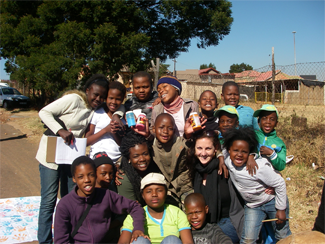 Thoughtful Path: Munsieville brought women from the community together to come up
with a plan to help each other build gardens in the community. A total of 74 women
attended the initial meeting. The women divided into 15 groups and decided that,
each woman who had a garden built in her yard, would need to help at least two other
women build their gardens. Megan and Twanda identified sponsors for each garden to
get the project started. Sponsors from the United States provided funds for seedlings,
soil, and chicken wire. The women receiving gardens had to collect bricks to build
the outer boundary of the garden and materials for the garden layers.
Thoughtful Path: Munsieville brought women from the community together to come up
with a plan to help each other build gardens in the community. A total of 74 women
attended the initial meeting. The women divided into 15 groups and decided that,
each woman who had a garden built in her yard, would need to help at least two other
women build their gardens. Megan and Twanda identified sponsors for each garden to
get the project started. Sponsors from the United States provided funds for seedlings,
soil, and chicken wire. The women receiving gardens had to collect bricks to build
the outer boundary of the garden and materials for the garden layers.
Twelve were built in the community in July 2011 and the women worked together to build each garden. The women made plans to help each other to make sure their gardens survived.
About a year after Megan and Twanda left, two additional ETSU College of Public Health students, Courtney Stanley and Sarakay Johnson, completed their internships in Munsieville. They were asked by the local Project Director to continue the keyhole garden project, expanding into another area of Munsieville, the community of Mshenguville, and to explore other methods to develop small scale gardening.
Courtney and Sarakay introduced GardenSoxx, a trademarked tubular device designed
for urban gardening GardenSoxx are made from mesh material and can be cut to any
desired size to create the perfect growing conditions for a garden witho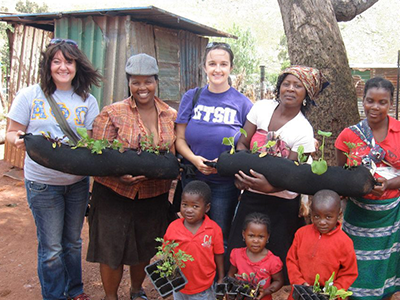 ut requiring much land or nutrient rich soil.
Since these initial efforts were implemented, the garden projects have greatly expanded and have become an important project for The Thoughtful Path: Munsieville. The garden project was re-invigorated in 2016, with an approach to introduce permaculture principles to the community and link it to the newly founded Hope Park nutrition unit. The garden project is now in a partnership with an organization called ‘Food and Trees for Africa’ and Checkers, a local grocery story. Through this partnership, close to 400 volunteers in Munsieville will receive monthly workshops permaculture workshops in Hope Park over an 18 month period.
To date, over 300 individual gardens at community members’ homes have been developed. A large community garden has also been established in the Mayibuye neighborhood of the community. The community garden is home to the permaculture workshop and will supply produce for Checkers grocery store in the future.