Dr. Zahner Publishes on Spinal Cord Injury
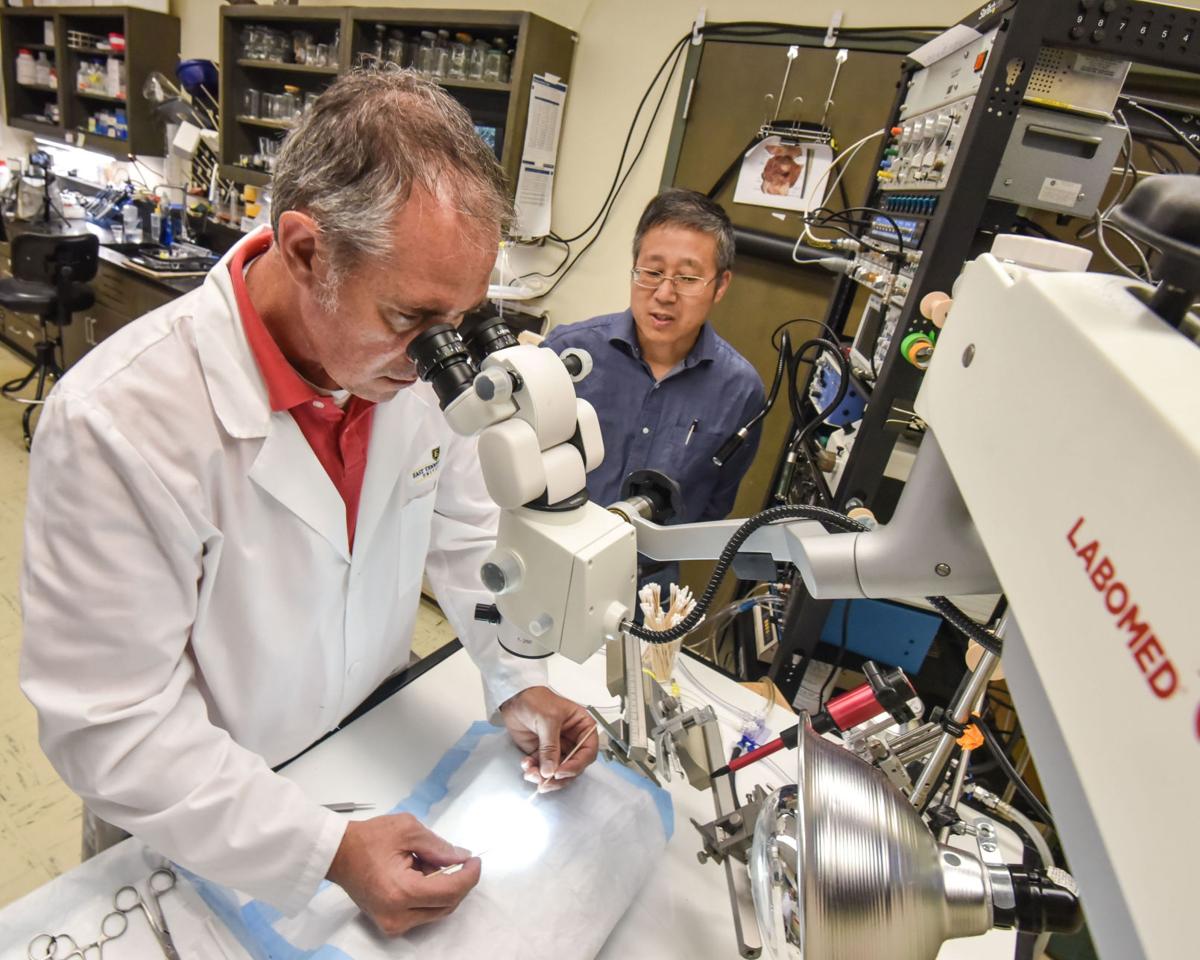
Dr. Matthew Zahner, Assistant Professor in the East Tennessee State University College of Public Health’s Department of Health Sciences, has published an article in Frontiers in Physiology. The article, “Intermittent Fasting After Spinal Cord Injury Does Not Improve the Recovery of Baroreflex Regulation in the Rat,” discusses caloric restriction in the rats and its impact on recovery from incomplete spinal cord injuries.
Dr. Eric Beaumont from the Quillen College of Medicine is co-author.
Baroreceptors are sensory cells that are located in the carotid sinus and in the aortic arch. They respond to changes in the tension of the arterial wall which enables them to quickly respond to changes in blood pressure; the mechanism used is known as the baroreflex. Moment-to-moment regulation of blood pressure is controlled by baroreceptor regulation of sympathetic and parasympathetic activity. After a spinal cord injury, the inability to produce sympathetically-mediated vasoconstriction when assuming an upright posture renders patients susceptible to loss of consciousness because of insufficient blood flow to the brain.
Modest recovery of somatic function after incomplete spinal cord injury has been widely demonstrated. Dr. Zahner’s lab has shown that spontaneous recovery of baroreflex regulation of sympathetic activity also occurs in rats and dietary restriction in the form of every other day fasting has been shown to have beneficial effects on the recovery of motor function after spinal cord injury in these animals.
The goal of this study was to determine if every other day fasting augments the improvement of baroreflex regulation of sympathetic activity after chronic left thoracic (T8) surgical spinal hemisection. To determine this, the team performed baroreflex tests on a group of rats fed normally and on a group of rats subjected to every other day fasting. The tests occurred one week or seven weeks after left T8 spinal hemisection.
One week after T8 left hemisection baroreflex testing revealed that gain of baroreflex responsiveness, as well as the ability to increase renal sympathetic nerve activity at low arterial pressure, was significantly impaired in the ad-lib fed but not the fasting rats compared with sham lesioned control rats. However, baroreflex tests performed 7 weeks after T8 left hemisection revealed the inability of both ad-lib and fasting rats to decrease renal sympathetic nerve activity at elevated arterial pressures. While there is evidence to suggest that every other day fasting has beneficial effects on the recovery of motor function in rats, the fasting did not significantly improve the recovery of baroreflex regulation of sympathetic activity.
Frontiers in Physiology is a leading journal in its field, publishing rigorously peer-reviewed research on the physiology of living systems, from the subcellular and molecular domains to the intact organism, and its interaction with the environment.