Alex Hopke, PhD, presented a talk and a poster at the Immunology 2024 conference in Chicago, Illinois. The event is the conference of the American Association of Immunologists (AAI) and is the largest annual all-immunology event worldwide.
His oral presentation was in the block symposia “Cellular Responses to Microbial and Parasitic Infections." The talk was titled "Characterization of the molecular mediators of neutrophil swarming against Candida albicans." Dr. Hopke's poster was also the same title.
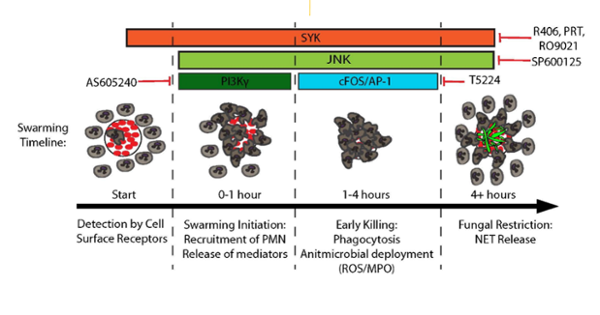
Dr. Hopke describes his research presented at the conference: "The molecular signals controlling neutrophils’ activities during the swarming process are just emerging and much remains to be characterized. Taking advantage of the ability to monitor large arrays of swarms using our microscale devices, we quantified the effect of chemical inhibitors and receptor antagonists on different phases of human neutrophil swarming to begin to address this knowledge gap. As examples of our findings from this screening so far, we found that spleen tyrosine kinase (SYK) signaling plays a critical role in regulating human neutrophil swarming, with SYK inhibition severely impairing swarming responses and resulting in the complete loss of fungal restriction. Furthermore, we found that PI3Ky signaling is critical in regulating the early stages of swarming, while the activation of JNK signaling is essential for the activation of biochemical antifungal functions. These findings advance our understanding of neutrophil swarming biology in humans and lay the foundation for understanding the role of neutrophil swarming in infection and inflammation."
Dr. Hopke is an Assistant Professor in the Department of Biomedical Sciences, Quillen College of Medicine. He is a member of the Center of Excellence in Inflammation, Infectious Disease, and Immunity.
 |
Co-Authors: Tasha Phillips, East Tennessee State University; Daniel Irimia, Massachusetts General Hospital, Harvard Medical School; Michael Mansour, Massachusetts General Hospital, Harvard Medical School |