East Tennessee State University scientists Dr. David L. Williams and Dr. Douglas W. Lowman are authors for a publication in Genes to Cells titled, “Self-recognition through Dectin-1 exacerbates liver inflammation” with collaborators from Osaka University, Osaka, Japan.
Viral hepatitis has been more well-studied in the literature than sterile hepatitis, even though sterile hepatic conditions such as non-alcoholic fatty liver disease (NAFLD) and nonalcoholic steatohepatitis (NASH) are significant causes of morbidity. Dectin-1 is a well-characterized C-type lectin receptor involved in anti-fungal innate immunity through the recognition of polysaccharides. In this study, the authors reported that Dectin-1 recognizes an endogenous glycogen-like Dectin-1 agonist found in the liver. The interaction between the endogenous agonist and Dectin-1 contributes to the exacerbation of NASH. The results from this research highlight a role of self-recognition through Dectin-1 that triggers hepatic innate immune responses and contributes to the exacerbation of hepatic inflammation in pathogenic settings. Thus, the blockade of this axis may provide a therapeutic option for liver inflammatory diseases.
Dr. Williams is a Professor in the Department of Surgery at Quillen College of Medicine.He serves as the Carroll H. Long Chair of Excellence for Surgical Research and is a CIIDI Co-director.Dr. Lowman is an adjunct Associate Professor in the Department of Surgery at Quillen College of Medicine and is a CIIDI member. Collaborators is this research include the Laboratory of Molecular Immunology in the Immunology Frontier Research Center at Osaka University, Osaka, Japan; Department of Mycobacteriology, Leprosy Research Center, National Institute of Infectious Diseases, Tokyo, Japan; Management Department of Biosafety, Laboratory Animal and Pathogen Bank, National Institute of Infectious Diseases, Tokyo, Japan; Laboratory of Molecular Biophysics, Institute for Protein Research, Osaka University, Osaka, Japan; Department of Molecular Immunology, Research Institute for Microbial Diseases, Osaka University, Osaka, Japan; Center for Infectious Disease Education and Research (CiDER), Osaka University, Osaka, Japan; Division of Molecular Immunology, Medical Mycology Research Center, Chiba University, Chiba, Japan; Division of Molecular Design, Research Center for Systems Immunology, Medical Institute of Bioregulation, Kyushu University, Fukuoka, Japan.
|
Authors (CIIDI Member in bold.) Shota Torigoe Douglas W. Lowman Toshihiko Sugiki David L. Williams Sho Yamasaki |
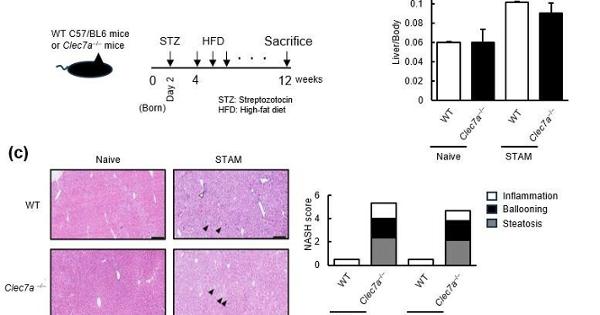 |
NASH-induced liver pathology was improved in Dectin-1-deificient mice. A: Experimental procedure of STZ & HFD- induced NASH model. B: Ratio of liver/body weight in NASH model after 8 wks. C: H&E stain of liver sections from untreated & NASH model, 8 wks.Scoring of NASH by counting inflammatory foci, ballooning cells, and lipid containing cells. Scale bars, 100 microns. |
To view the full article, click here: Investigate