 Dr. Qian Xie is the corresponding author for a recently published article in the Journal
of Translational Medicine titled “Efficacy of MET-targeting CAR T cells against glioblastoma
patient-derived xenograft models.” Glioblastoma (GBM) is the most common and malignant
primary brain tumor without effective treatment; these tumors are highly resistant
to radiation and chemotherapeutic treatment modalities.Genetic alteration of the Mesenchymal-epithelial
transition factor (MET) receptor tyrosine kinase frequently occurs in GBM.While MET
has been a promising therapeutic target, MET inhibitors have not been successful in
treating GBM patients. MET-directed chimeric antigen receptor (CAR) T cells hold the
promise of targeting MET-positive GBM regardless of genetic alterations or kinase
activity.
Dr. Qian Xie is the corresponding author for a recently published article in the Journal
of Translational Medicine titled “Efficacy of MET-targeting CAR T cells against glioblastoma
patient-derived xenograft models.” Glioblastoma (GBM) is the most common and malignant
primary brain tumor without effective treatment; these tumors are highly resistant
to radiation and chemotherapeutic treatment modalities.Genetic alteration of the Mesenchymal-epithelial
transition factor (MET) receptor tyrosine kinase frequently occurs in GBM.While MET
has been a promising therapeutic target, MET inhibitors have not been successful in
treating GBM patients. MET-directed chimeric antigen receptor (CAR) T cells hold the
promise of targeting MET-positive GBM regardless of genetic alterations or kinase
activity.
In this study, Dr. Xie, her lab, and collaborators utilized GBM patient-derived xenografts (PDX) harboring MET amplification(METamp) or PTPRZ-MET fusion(ZM), which were propagated in vivo followed by glioma stem cell (GSC) isolation. Cell-based assays were used to compare GSC survival in response to MET inhibitors and CAR T cells. Multi-panel cytokine release was analyzed to profile MET-CAR T cell activation during co-culture with GBM. Orthotopic tumor growth and real-time imaging were performed to evaluate MET-CAR T cell therapeutic efficacy in vivo.
The study showed that whereas MET inhibitors are effective only in MET-active tumors, MET-CAR T cells eradicate MET-positive GBM growth in an antigen-dependent manner regardless of MET pathway activity, demonstrating a novel therapeutic approach for GBM treatment. It also suggests that MET-overexpression, especially METamp and ZM fusion may be used as biomarkers to predefine the GBM patients suitable for MET-CAR T cell therapy.
Dr. Xie stated, “This study is the continuation to our previous one where we showed MET-CAR T cells effectively inhibited liver cancer tumor growth in preclinical models. Anna Qin and Anna Musket have played major roles in both studies. I also want to thank all the collaborators for their support to this project. We will continue this research to optimize and improve MET-CAR T cell therapy."
Dr. Qian Xie is an associate professor in the Department of Biomedical Sciences and is a CIIDI member.
Authors (CIIDI Member in BOLD): Anna Qin,Anna Musket,Benjamin Hilton,Johanna Preiszner,Giedre Krenciute,Michael E. Berens,Mingyao Ying,Phillip R. Musich, Qian Xie
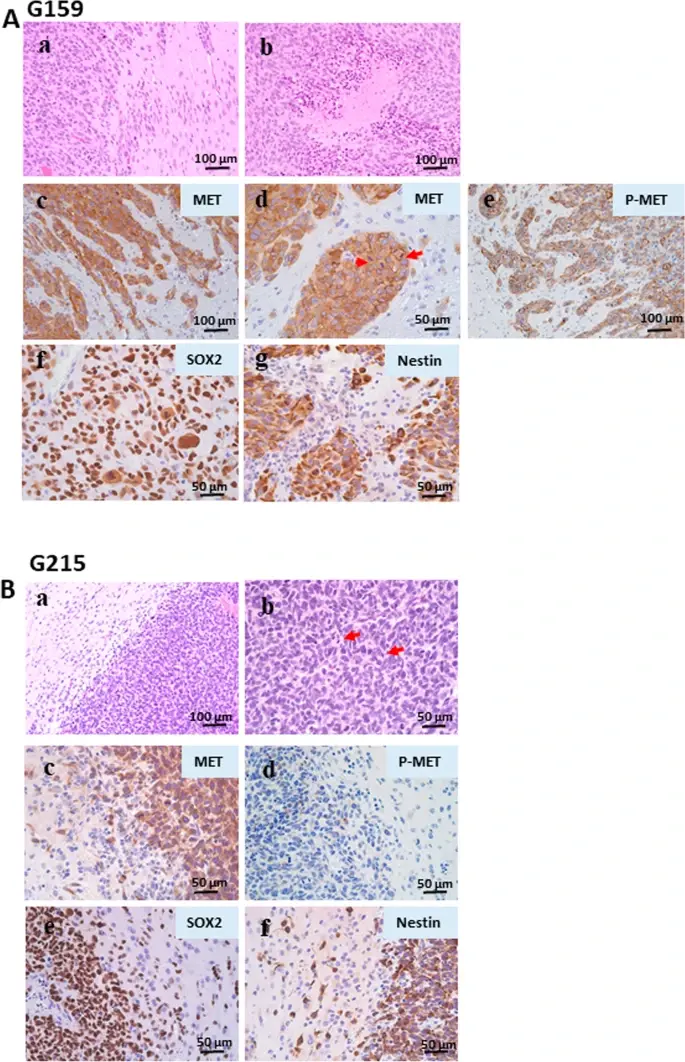 Characterization of GBM-PDX orthotopic tumor growth. A Representative H&E images of
G159 orthotopic tumor growth including invasive tumor growth (a), central necrosis
(b), and IHC staining for MET (c-d), p-MET (e), SOX2 (f) and nestin (g) expression
levels. Red arrows (d) indicate mitotic cells. B Pathological analysis of G215 orthotopic
tumor growth using H&E (a,b) and IHC staining (c-f). Note that G215 tumors demonstrate
a less invasive phenotype as compared with G159 tumors (A a, c). While tumors were
positive for MET (c), SOX2 (e) and nestin expression (f), p-MET expression was negative
(d)
Characterization of GBM-PDX orthotopic tumor growth. A Representative H&E images of
G159 orthotopic tumor growth including invasive tumor growth (a), central necrosis
(b), and IHC staining for MET (c-d), p-MET (e), SOX2 (f) and nestin (g) expression
levels. Red arrows (d) indicate mitotic cells. B Pathological analysis of G215 orthotopic
tumor growth using H&E (a,b) and IHC staining (c-f). Note that G215 tumors demonstrate
a less invasive phenotype as compared with G159 tumors (A a, c). While tumors were
positive for MET (c), SOX2 (e) and nestin expression (f), p-MET expression was negative
(d)