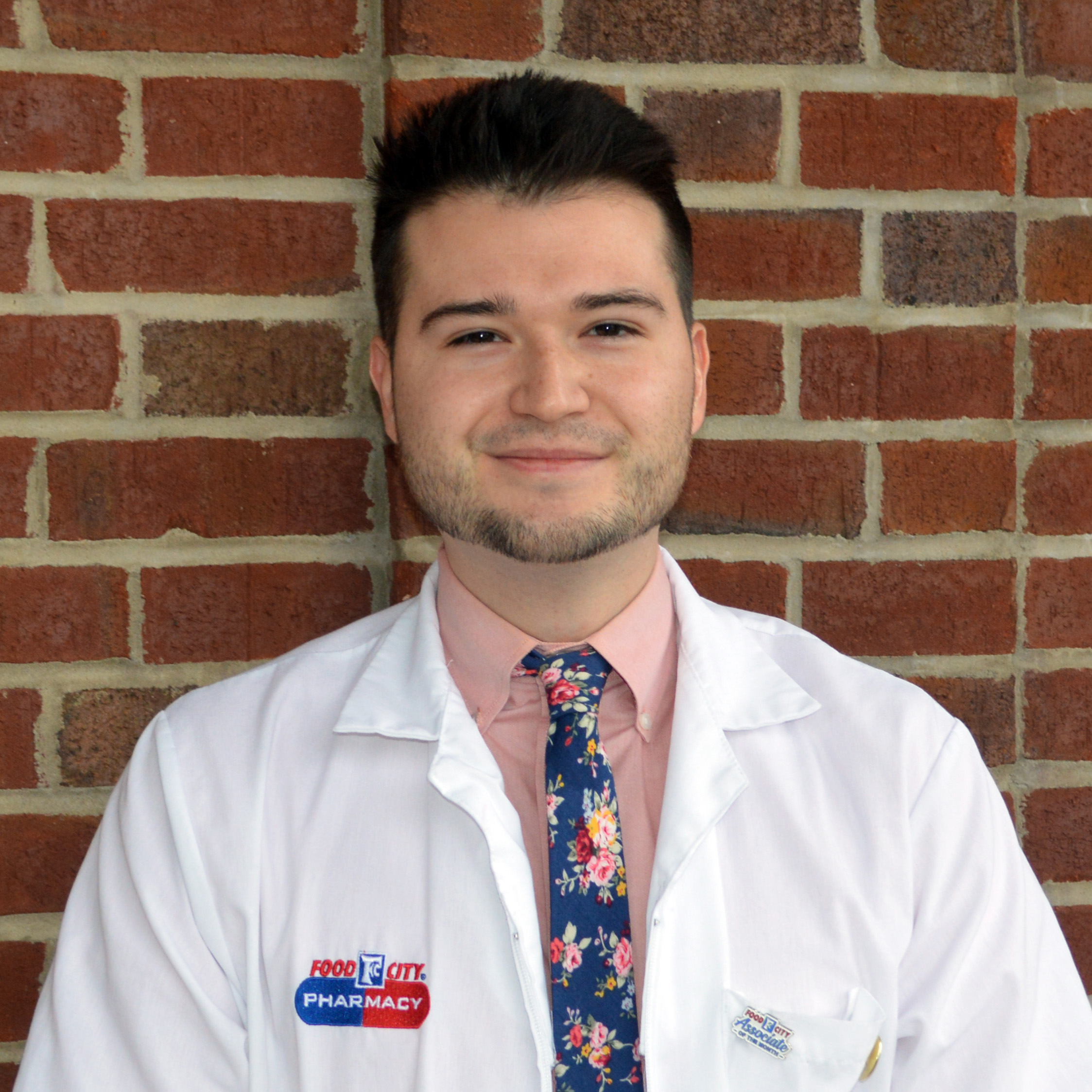
When East Tennessee State University (ETSU) Bill Gatton College of Pharmacy alumnus Hayden Stanton (’22), PharmD, MBA, went to work at Food City Pharmacy in early December, it was just another day in the life of a community pharmacist: verifying prescriptions, giving vaccinations, and counseling patients to aid in taking medications effectively.
But what he didn’t expect was a medical emergency that would have him go beyond his usual community pharmacy role and put his medical training to the test.
Katie Callerhorn, a current medical student at ETSU Quillen College of Medicine, was experiencing what she thought was an allergic reaction and having trouble breathing—she needed to get medical help quickly.
The closest place she found was the Food City Pharmacy on North State of Franklin in Johnson City, Tennessee. Knowing it was a pharmacy, she knew she could rely on the local pharmacist to get help quickly and speak to a medical professional like Stanton who was managing the pharmacy that day.
“She was crying, very short of breath and red in the face,” said Stanton. “Physically, she was in distress.”
Having only been a professional pharmacist for less than a year after graduating from ETSU Gatton College of Pharmacy in spring 2022, he stayed calm, quickly retrieved an EpiPen, and invited her to the patient counseling room. He asked her if she wanted to administer it, or him; when she chose to, he walked her through the steps.
After offering EMS and administration of the epinephrine, Stanton comforted Callerhorn by offering her his coat to bundle up in, water, and even showing her pictures of his cats to help calm her.
“I thought that would help,” said Stanton, smiling. “I have pretty cute cats.”
Callerhorn believed he took all the right precautions for this medical emergency: staying calm, going through procedures, and ultimately helping the patient get the treatment they needed.
“He did all the right things in a scary situation, and I am so thankful for him,” she said. “Although our interprofessional education/communications (training scenarios) may not have given him someone like me, I definitely felt that he channeled some communication skills in our encounter that, on the other side as a patient, really helped.”
In addition to his clinical rotations at ETSU, Stanton said his patient communications training really paid off during this moment. ETSU’s medical, nursing, and pharmacy students all participate in an interprofessional education skills training for patient interaction that involve various scenarios with “standardized patients,” actors from the community hired to model patients and act out their symptoms.
“It gave me a better arsenal and made me more prepared for a scenario like that,” he said. “(Communications training) builds a lot on your professional personality … You can’t teach empathy and you can’t teach how to be caring, passionate, and loving. That comes from each person’s heart, personality, and their love for the profession. But (communications training) can definitely better prepare you for some scenarios you may see.”
For Stanton, this medical emergency spoke to the important role pharmacists have in our community.
“This is the whole reason why I got into pharmacy,” said Stanton. “You don't have to have an appointment to come see us. You don't have to pay a co-pay to come see us. We are part of the community as accessible health professions who are always willing to serve when needed.”
Over the next decade and beyond, Stanton says he hopes the role of the pharmacist continues to evolve.
“I see (pharmacists) more hands on as far as being a part of the actual health care team. Gatton did a great job training us as students to work with nurses, medical students, and trying to incorporate everything as a team.”
“At the end of the day, it’s all patient-centered care,” said Stanton. “That’s what we’re there for.”