College of Nursing

Excellence and Innovation in Nursing

The East Tennessee State University College of Nursing is committed to improving the health of our region through excellence and innovation in nursing education, research, service, and practice.

As one of the largest colleges of nursing in the southeast, ETSU is playing a critical role in addressing the healthcare needs of individuals, families, and communities in Tennessee and beyond. 

Illustration of a nurse holding a trophy

#1 Best RN to BSN Program in Tennessee

(NursingProcess.org)

Illustration of a student sitting at a desk looking at a laptop

#1 Best Online MSN Program in Tennessee

(RegisteredNursing.org)


Illustration of two nurseing students side hugging and holding a trophy

#2 Top Ranked Tennessee Online NP Program

(NursePractitionerOnline.com)


Illustration of three medical professionals standing together

#2 Best Online RN to BSN Program in Tennessee

(RegisteredNursing.org)


Nursing Programs Offered at ETSU

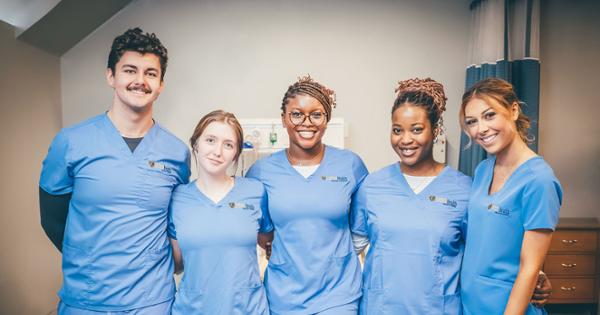
Two ETSU nursing students engaged in a discussion during a seminar

CERTIFICATES*
Post-Graduate APRN Certificate 
- Adult-Gerontology Primary Care Nurse Practitioner
- Family Nurse Practitioner
- Psychiatric Mental Health Nurse Practitioner
Health Care Genetics and Genomics Post-Baccalaureate
Post-Graduate Nursing Administration Certificate


The Power of Language: Our Words, Our Identity, Our Future

When non-professional language is normalized, what message does that send to future nurses?


  • Descriptive Transcript

    Descriptive Transcript

    Video Title: The Power of Language: Our Words, Our Identity, Our Future

    Opening Sequence

    [Visual Description]

    The video opens with a fast-paced montage divided into multiple rectangular panels. Nurses and healthcare professionals walk through hospital hallways, review charts, and work in clinical and laboratory environments. A close-up shows gloved hands handling medical tools and lab materials.

    [On-Screen Text]

    “The Power of Language: Our Words, Our Identity, Our Future.”

    Dr. Dena Evans, Dean, ETSU College of Nursing

    Dr. Dena Evans: “Our college of nursing is one of the largest colleges of nursing in the state of Tennessee. And we produce a large portion of the nursing workforce in this area.”

    [Visual Description]

     Dr. Dena Evans sits on a dark sofa in a softly lit office. A window behind her allows in natural daylight. A small side table with a lamp is visible to her right. She faces the camera directly while speaking.

    [B-Roll – appears during this segment]

    Nursing students wearing scrubs walk through academic hallways. A classroom scene shows students seated while an instructor gestures at the front of the room.

    Dr. Ralph Lugo, Senior Associate Dean, ETSU Bill Gatton College of Pharmacy

    Dr. Ralph Lugo: “When professionals seek to be trained, they have access to funds from loan sources, and that allows them to complete their training. And the total amount that professionals can actually access is a total of about $200,000 over their training period. So it gives them adequate resources to be able to fund their training. When you apply the label of non-professional, the amount goes down by about half in terms of the accessibility of funds. It especially affects those that are seeking graduate education because they cannot get access to the same amount of funds as a pharmacy student would or a medical student would or other health professionals as designated by the federal government.”

    [Visual Description] Dr. Ralph Lugo is seated in a professional interview setting. He wears a suit and glasses. A lamp and light-colored wall are visible behind him.

    [B-Roll – appears while loan access is discussed] A student sits at a desk using a laptop, scrolling and typing. Another shot shows a student reviewing printed materials and writing notes.

    Dr. Dena Evans, Dean, ETSU College of Nursing

    Dr. Dena Evans: “The new guidelines for the federal loan limits don’t specifically say that nursing is a non-profession, but the implications from using that language are quite clear to the nursing profession, which has for decades struggled to be recognized as a profession. It's worked very hard in that arena. So my fear is that by using that language and limiting the borrowing power of nurses who want to become advanced practice registered nurses, that's going to impact our ability to recruit nurses into those very impactful roles in this area. And I don’t think that people understand that advanced practice registered nurses, especially our nurse practitioners, actually provide about 55% of primary care in the state of Tennessee, over 60% in rural areas of the state.”

    [Visual Description]

    The camera returns to Dr. Evans in the same office setting.

    [B-Roll – appears as advanced practice and rural care are discussed]

    Nurses provide bedside care in a clinical training environment. One nurse uses a stethoscope while another adjusts the patient’s arm. Medical equipment and wall-mounted devices are visible. The patient’s face is not shown.
    Exterior shots of healthcare buildings and clinics appear briefly.

    Dr. William Block, VP for Clinical Affairs and Dean, ETSU Quillen College of Medicine

    Dr. William Block:

    “It’s important to understand that all of the people that participate in the health care team do so in a professional capacity and for their, really, their career and for their profession. And so to label any member of that team as a lesser contributor really harms the entire team.”

    [Visual Description]

    Dr. William Block appears seated in an office-like setting. He wears a dark suit and tie. A window and lamp are visible behind him.

    [B-Roll – appears during this segment]

    Healthcare professionals walk together through a corridor. Hands are shown passing paperwork and adjusting equipment.

    Steve Ellis, Assistant Dean of Student Affairs, ETSU Bill Gatton College of Pharmacy

    Steve Ellis:

    “I think there is still this very old viewpoint by many policymakers that nurses are the angels in white, and they are, they are, but nurses are more than that, they are integral members of the health care team. They are providing many times the frontline care, especially in primary care. So I think the policymakers have to really look at the workforce and what’s being done, and not just trying to look at the various criteria that you can put on the labels that are associated with a degree.”

    [Visual Description]

    Steve Ellis stands indoors in a professional hallway or office area. He wears a patterned blazer and collared shirt. Neutral-colored walls and a doorway are visible behind him.

    [B-Roll – appears during discussion of frontline care]

    Nurses move through clinical spaces, review charts, and perform hands-on care tasks.

    Dr. Jeff Snodgrass, Dean, ETSU College of Health Sciences

    Dr. Jeff Snodgrass:

    “Our college represents about 14 distinct health care disciplines. And if you look collectively at all of those health care disciplines, that represents roughly 50% of all of health care workforce. So, if you look at the overall impact for this state in the region, it’s quite significant, given that health care represents roughly 18 to 20% of gross domestic product in this country anyway.”

    [Visual Description]

    Dr. Jeff Snodgrass is seated in a professional interview setting wearing a suit and tie.

    [B-Roll – appears during workforce discussion]

    Wide shots show busy healthcare facilities and academic spaces with students and professionals moving through hallways.

    Dr. Megan Quinn, Associate Dean, ETSU College of Public Health

    Dr. Megan Quinn: “The professional workforce is vital to our communities in Tennessee, especially our rural communities, and being able to know that our professional workforce can receive the funding and the degree programs that they’re looking for so that they can turn around and help care for our communities is integral to Tennessee’s health and well-being.”

    [Visual Description]

    Dr. Megan Quinn appears in an office or conference room. A whiteboard with faint writing and several empty chairs are visible behind her.

    [B-Roll – appears during this segment]

    Nursing students prepare equipment and interact in learning environments.

    Closing Statements

    Dr. Jeff Snodgrass: “This is not non-professional work. This is life-saving work.”

    [Visual Description]

    Dr. Snodgrass appears briefly again in his interview setting.

    Dr. Ralph Lugo: “Stand with us in honoring health care professionals, the backbone of Tennessee.”

    Steve Ellis: “Together.”

    Dr. Megan Quinn: “Together.”

    Dr. William Block: “Together.”

    Dr. Dena Evans: “Together, we are ETSU Health.”

    [Visual Description]

    Quick cuts show each speaker in their respective interview settings as they say the word “Together.”

    Final Branding

    [Visual Description]

    The Tennessee Center for Nursing Advancement and the ETSU Health logo appear centered on screen. The Tennessee Center for Nursing Advancement logo features the name inside a circle, with an illustration of Tennessee's shape and the tri-star icon from the Tennessee state flag. The logo includes the ETSU name and health branding elements. The screen fades to black.


Latest News

Hands-On Nursing Experience 

At ETSU, nursing students get more than a degree — they gain real-world skills through various hands-on experiences. 

Aaron Fregoso, a first-generation nursing student at ETSU, has dedicated his college journey to serving others. Through ETSU’s College of Nursing, he gained hands-on experience in clinical rounds, working alongside experienced healthcare professionals and learning to provide compassionate, patient-centered care.


Request Admissions Information


Student Outcome Data

The College of Nursing provides students with a high-quality education that prepares them for success upon graduation, with exceptional pass rates year after year. 

  • NCLEX-RN Pass Rates (First Time Takers)

    2024 = 93%

    2023 = 90%

  • Certification Pass Rates (2024)
    ANCC PMHNP
    MSN
    100%
    ANCC FNP
    MSN
    95.25%
    AANP FNP
    MSN
    89%
     
    Post Grad
    89%


Outside of Nicks Hall in the fall

Message from the Dean

I am extremely honored to serve as Dean of the ETSU College of Nursing. Having dedicated my career to advancing nursing education and addressing health equity, I am truly inspired by the college's commitment to serving the needs of our region. Growing up in rural North Carolina, I deeply understand the critical role nurses play in underserved communities, and I am eager to contribute to ETSU's legacy of excellence.

The College of Nursing is dedicated to training the next generation of nurses. We aim to further enhance our programs, expand our reach, and ensure that our graduates are well-equipped to meet the evolving health care demands of our communities.

Dr. Dena Evans
Dean of the ETSU College of Nursing
CCNE logo The baccalaureate degree program in nursing, master’s degree program in nursing, Doctor of Nursing Practice program and post-graduate APRN certificate programs at East Tennessee State University are accredited by the Commission on Collegiate Nursing Education. Click here to open in a new window or copy and paste this link: http://www.ccneaccreditation.org to an Internet browser of your choice.

The ETSU College of Nursing programs are approved by the Tennessee Board of Nursing.  Tennessee Board of Nursing, 665 Mainstream Drive, Nashville, TN 37243 Telephone 1.615.532.5166


Notice: Regulatory requirements governing student clinicals vary by state and are subject to change. Clinical placement outside of Tennessee is contingent upon approval by the appropriate regulatory bodies and will be evaluated on an individual basis upon admission to the program.


2025.07.23.01 v. 854 | Office of the Dean