ETSU.edu Web Strategy

We’re building a new ETSU.edu from the ground up. Here’s why.
It’s a good problem to have. Because of the innovation and growth occurring at ETSU, we have outgrown our current website.
ETSU deserves a website that:
- More effectively reaches and resonates with prospective students, driving enrollment
- Delivers our core messages more clearly and compellingly
- Provides campus communicators with a better content management experience
- Is built to grow with advances in digital communications technology — especially AI
Here's the scoop on what our web team's been working on this month. Jump to the Monthly Progress Report👇
What You Need to Know About the New ETSU.edu
This is nothing short of a complete overhaul. We are redesigning the site from the ground up on Drupal, a widely used and flexible Content Management System (CMS).
These are significant changes, and they will take time to implement correctly.
To support this effort, the Office of University Marketing and Communications (UMC) has engaged a wide variety of stakeholders from across campus, hired additional personnel for the duration of the project, and engaged an external consulting company through a competitive national RFP process.

Building a New Home for ETSU’s Web Presence: How the Redesign Will Work
We estimate that the project will take three years, spanning from spring 2026 through spring 2029.
At a high level, we think of this project as building a new home for ETSU’s web presence:

In the spring and summer of 2026, we developed blueprints and building plans and laid foundations. We selected vendors, developed an information architecture, and began configuring Drupal in preparation to launch new webpages.

In the fall of 2026, we will focus on building front doors. We will design and launch a new home page and other high-visibility landing pages for each major section of the site.

In 2027, we will build out entryways — areas of the site devoted to welcoming prospective students into our community, including the admissions site, a new program finder, program landing pages, and other priority sites.
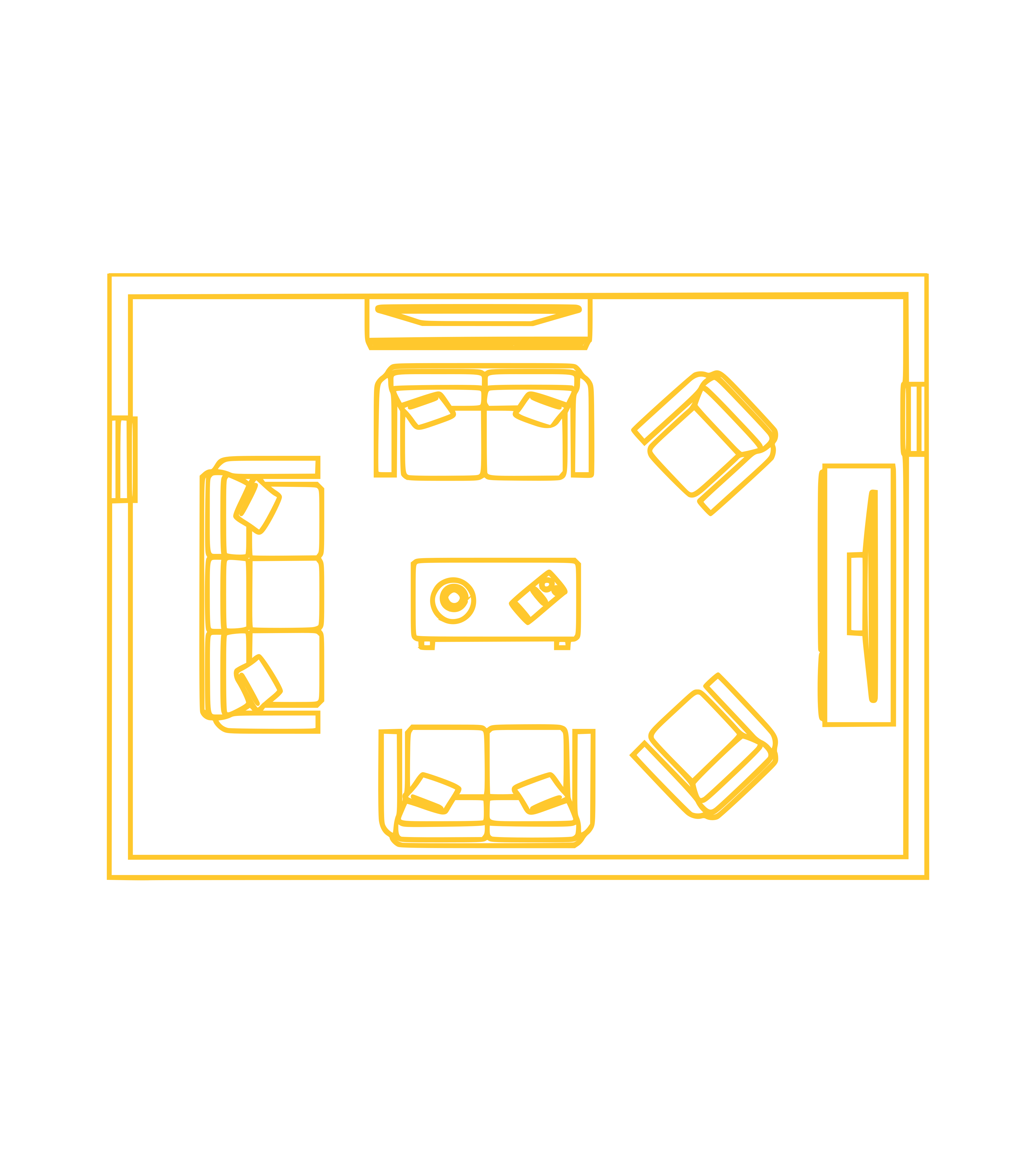
In 2028 and beyond, we will pivot to building out interior rooms — sites and pages for academic and administrative units.
Project Roadmap: 2026-27
The table below gives a detailed view of UMC’s roadmap for the first year of the project. These dates are subject to change, and any substantive changes will be published here and detailed in our project communications.
-
Timeline
November-December 2026
New Pages Launching Existing Pages Replaced Homepage Homepage Academics homepage Undergraduate and Graduate programs pages Program Finder (initially linking to existing program landing pages or the catalog) Trailblazers (research) homepage Research homepage Apply (admissions) homepage Admissions homepage Roan Scholars site Roan Scholars site ETSU News site ETSU News site January-February 2027
New Pages Launching Existing Pages Replaced Existing program landing pages migrated Existing program landing pages developed by UMC Academic Health Sciences Center site Academic Health Sciences Center site Bucs Go Beyond (community-engaged learning) page Community-Engaged Learning page Unified Student Support page (one-stop page linking to student resources) March-June 2027
New Pages Launching Existing Pages Replaced Undergraduate and Graduate Admissions sites Undergraduate Admissions site Phil and Martha Bachman College of Arts and Sciences program pages Graduate Admissions site June – December 2027
New Pages Launching - Remaining program pages for: CBAT - Remaining Program Pages Only (remaining CBAT site to be migrated at a later date) Clemmer - Remaining Program Pages Only (remaining Clemmer site to be migrated at a later date) Gatton College of Pharmacy - Remaining Program Pages Only (remaining College of Pharmacy site to be migrated at a later date) Nursing - Remaining Program Pages Only (remaining Nursing site to be migrated at a later date) Quillen College of Medicine - Remaining Program Pages Only (remaining College of Medicine site to be migrated at a later date) Health Sciences - Remaining Program Pages Only (remaining Health Sciences site to be migrated at a later date) Public Health - Remaining Program Pages Only (remaining Public Health site to be migrated at a later date)
What to Expect During the Project, and What’s Changing
As with any major transition, the website redesign is a good opportunity to revisit and reimagine how the website itself and UMC’s strategy for managing it serve our audience and our stakeholders.
Here are some of the changes that will come about during this project:
-
Your Unit’s Content in its New Home
Think of the new ETSU.edu as a thoughtfully designed new home for your unit’s web presence, and think of the existing content on your current pages — text, images, embedded elements — as furniture.


In moving to a new house, you’ll likely keep a good portion of your furniture, but it will be configured differently based on the new house’s floor plan. And some of your furniture may be outdated or unnecessary in the new house.
The same goes for your unit’s web presence. You’ll likely need to do some shifting, reorganizing, and recycling of content to fit it into its new home.
But remember, this new home is an upgrade. We are developing templates, content types, and components to help you get your message to your audience more effectively — and with less effort.


Some content types, like faculty and staff directories and program landing pages, will be developed and managed globally by UMC in consultation with campus partners. And some pages, like department homepages, will be templated, so that our partners don’t have to start with a blank slate.
A New Governance Structure and Unit Web Leads
To effectively partner with your team, university leadership has appointed Unit Web Leads across campus to be our main points of contact for the migration. We will be in close communication with these individuals both during and after the migration.

Unit Web Leads will also serve as editors for your site’s content, meaning that they will be responsible for either making or approving all additions and changes to content.
This is a shift from our previous governance structure, where any faculty or staff member with leadership approval was granted editing access.
After migration, some units may need to appoint additional content authors. But, because leadership has assigned Unit Web Leads to work closely with UMC, not all current content editors in Modern Campus will need access to edit the new site.
Unit Web Leads
Unit(s) or Division(s) Unit Web Lead Capital Planning, Facilities Operation, Emergency Management, & ETSU Police Ben Daugherty Human Resources Ben Daugherty Office of Business and Finance Ryan Seale ETSU Online Lindsey Campbell ITS Adam Greever Undergrad Enrollment (Undergrad, International, New Student & Family Programs, Housing) Emily Goepel Student Success (Jordan Center, Dean of Students, Robertson Center, Counseling, Advising, Disability, Testing, TRIO, Career Services, etc.) Jake Rodeback BucCentral (Bursar, Registrar, Financial Aid & Scholarships) Kayla Carter Campus Experience (Campus Rec, Activities & Orgs, Culp Student Center, etc.) Heidi Marsh University Advancement and Foundation Joe Smith Alumni Association Lee Ann Davis Martin Center for the Arts Sara Allen Additional Instructional Sites (Sevierville, Kingsport) Brandi Huskey Planning and Decision Support Mike Hoff Community Engaged Learning Susan McCraken & Nathan Farnor Center for Teaching Excellence Alison Barton Transfer & Adult Student Outreach Bill Flora Graduate School Don Rice All other Academic Affairs Claire Shoun Office of the Vice Provost for Research Angela Campany Phil and Martha Bachman College of Arts and Sciences Sam Riner College of Health Sciences Maggie Branch Quillen College of Medicine Kristen Early College of Nursing Logan Mink Bill Gatton College of Pharmacy Stephen Woodward College of Public Health Amanda Peterson College of Business and Technology Ben Murphy Clemmer College of Education and Human Development Nick Papworth University School Thomas Moore Honors College Susan Kellogg University Marketing and Communications Amerrica Duggan-Torbert University Counsel Kay Lennon McGrew Office of the President (President's Office, Government Relations, Board of Trustees, Internal Audit) Amanda Mowell ETSU Research Corporation Stephen Marshall & Betsy Cunningham -
Dedicated, Proactive, and Continued Support from the UMC Web Team
Academic and administrative units will be assigned a dedicated member of the UMC Web Team who will work with your unit’s web lead and other key stakeholders to review your existing content and determine how best to migrate and arrange it on the new site.
We will onboard departments ahead of their planned launch dates, which will be published on our master roadmap.
Monthly Progress Report
-
September
- Final design stage for the homepage, program finder, and program landing page
- Student, faculty, and staff feedback sessions for first three pages have been completed
- Unit Web Lead selection is being finalized
- Unit Web Lead kick-off meeting completed
- Next Unit Web meeting is scheduled for October 20 from 2:00 – 3:00 p.m. in room 106 of the Academic Building
-
Previous Updates
August
- Early designs for the homepage, program finder, and program landing page are in the works
- Student, faculty, and staff feedback sessions have been scheduled
- Final selection of Unit Web Leads is being conducted
- Unit Web Lead kick-off meeting and subsequent meetings have been scheduled