WRITING FOR INTERDISCIPLINARY STUDIES
GRADUATE LEVEL WRITING AND CRITICAL THINKING
In many ways, the graduate school experience can feel like round two of college—registering for courses, learning the campus layout, taking exams and writing papers. However, academic standards are much higher for graduate students than their undergraduate counterparts.
Students who come into the Master of Arts in interdisciplinary studies program after a lengthy hiatus from academia, or if their prior scholarly endeavors were seated firmly in the structure of a single discipline, might feel intimidated by the elevated expectations for their writing. Graduate level work must show a deeper and more complex level of exploration, analysis, and comprehension, and the workload typically proves considerably more demanding in terms of complexity and volume than what is required for undergraduates.
Graduate level writing must also meet higher standards for style, diction, and thoroughness of analysis and development. Perhaps the most fundamental skill students will need to develop as a graduate level writers is that of critical thinking—and writing.
Critical Thinking Demystified Handout
_________________________________________
INTERDISCIPLINARY WRITING
In choosing to pursue a degree in interdisciplinary studies, students recognize the advantage of a unique approach to research. Instead of adhering to the theories and methodologies of a single academic discipline (e.g., history, physics, political science), interdisciplinary research integrates the "knowledge domains" of two or more disciplines to achieve a more holistic understanding of a problem or phenomenon—an understanding that is only possible by combining disciplinary perspectives.
Interdisciplinary scholarship values the disciplines, and indeed cannot exist without them. However, to effectively address complex issues, integrating the insights, concepts, and methodologies and practical tools of multiple disciplines into an interdisciplinary approach is necessary. To learn more about the characteristics of interdisciplinary writing and research, view the handout linked below.
Key Characteristics Of Interdisciplinary Research And Writing
_________________________________________
WRITING AS A PROCESS
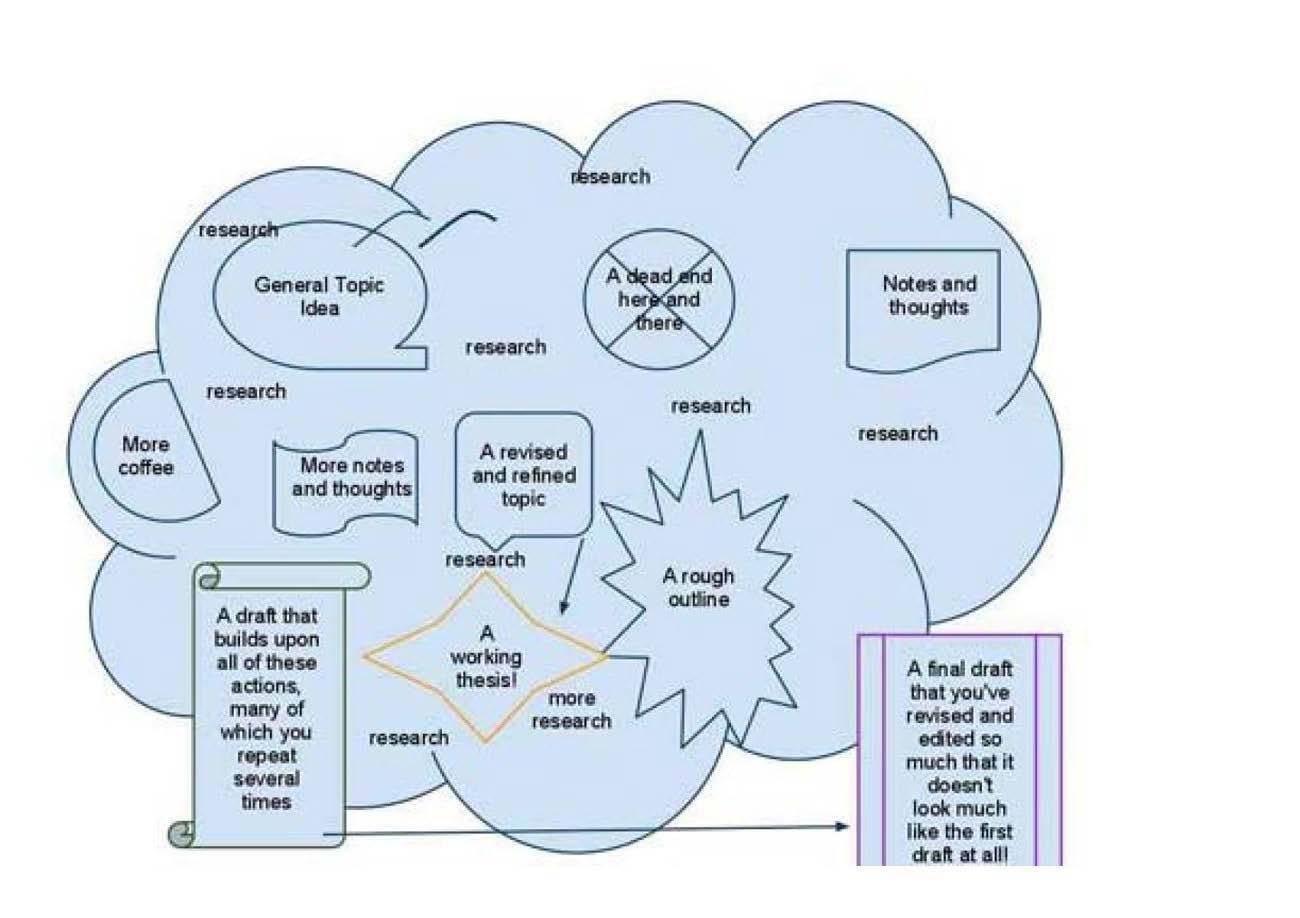
While there are steps one can follow to streamline the writing process, it is often difficult for writers to simply choose a topic, research that topic, form a thesis, and then type up a decent paper. If one focuses solely on the steps (topic, outline, draft), writing is framed as a recipe that results in a paper, and misses the point of writing as a learning experience.
Abandoning the notion that writers must have their thoughts clearly articulated in their heads before putting them on paper opens up the possibility of the writing process becoming a knowledge-creating activity.
A fundamental truth about the writing process is that it is rarely, if ever, linear. The writing process is an exercise in exploration, revision of both words and ideas, and even back-tracking. A visual interpretation of one's writing process might look like this:
Understanding the Assignment
Choosing A Topic
Determining Your Audience
Invention Techniques
Managing Your Research
The Evolving Thesis
Writing As Thinking On Paper
Arriving At a Working Thesis
_________________________________________
TYPES OF GRADUATE LEVEL WRITING
Graduate school is likely to present students with types of writing assignments that they are unfamiliar with. In core courses in this program, professors will ask students to complete everything from annotated bibliographies to papers for symposia. The following handouts cover many of the types of assignments professors will assign, and provide information about what is required for each assignment.*
Commonly Required Graduate School Writing Assignments:
Article Precis & Summary/Analysis
Annotated Bibliography
Research Prospectus
Seminar Paper
Thesis and Project Proposals
Conference Presentation Writing
Symposium Writing
*In addition to seeking guidance from these handouts, students should always consult with their syllabus and/or assignment sheet for additional details regarding their professors’ expectations for any given assignment.
_________________________________________
COMMON ERRORS AND SOLUTIONS
Graduate-level writing is held to a higher standard than undergraduate writing. Graduate
students not only have to demonstrate that they understand an issue, but must also
articulate a position on that issue while maintaining proper grammar, mechanics, diction,
style, and spelling. In addition, graduate students must make sure their sources are
appropriate to their research agendas.
While it is impossible for students to become experts at all of these components of
writing and research at once, students are expected to meet high standards for their
written coursework. Students can learn from their professors’ comments on graded work,
as well as seek the assistance of the Writing Consultant for help in improving repeated
mistakes.
The following handouts are designed to help students decipher comments from professors or the Writing Consultant, how to fix common errors, and know what to avoid before turning in written work.
Common Errors and Solutions
Characteristics of an Excellent Research Paper
_________________________________________
CULTURAL THEORY AND SCHOOLS OF CRITICISM
An integral part of interdisciplinary writing and research is the engaging of various theories and schools of criticism. Different critical and theoretical approaches can offer unique insights and perspectives on the issue or topic you are interested in studying. To successfully employ different theoretical approaches it is important to first familiarize yourself with them. The link below provides a list of resources concerning different theories and schools of criticism to help you get started. The list is not comprehensive but should provide a valuable jumping off point.