Prepare to lead at the intersection of environmental resilience, public health, and disaster response.
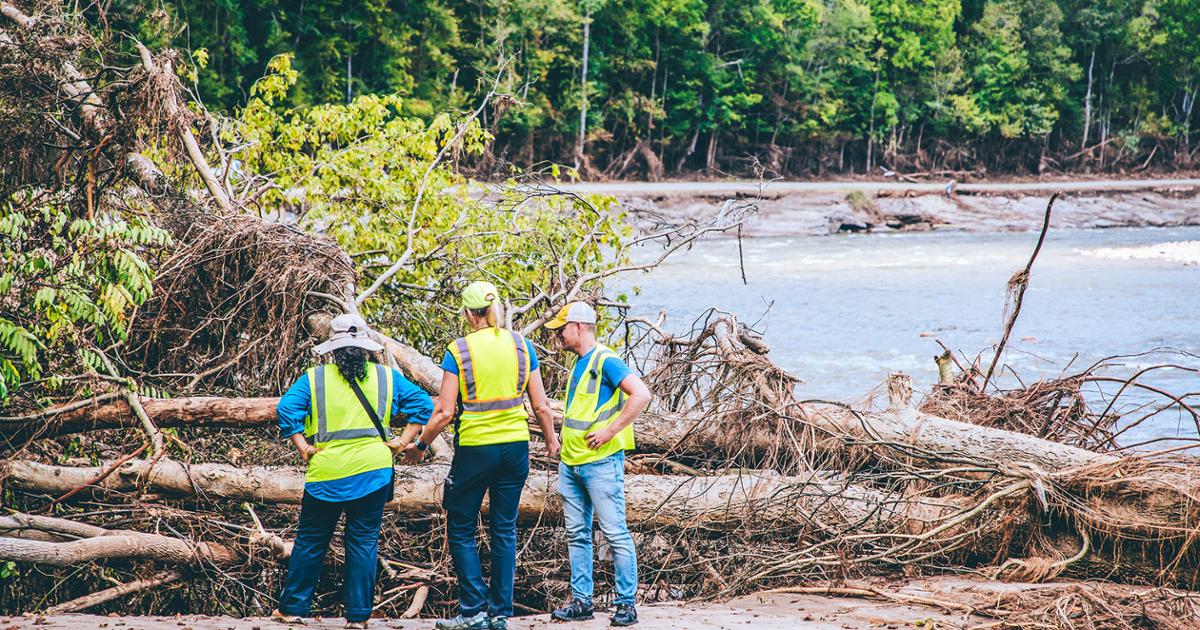
Floods. Wildfires. Emerging diseases. Environmental hazards that affect not just people, but animals, ecosystems, and entire communities.
ETSU’s Master of Science in Environment, Health, and Disaster Sciences prepares professionals to understand and respond to these complex challenges. This first-of-its-kind program in Tennessee offers two concentrations in disaster sciences and environmental health.
Designed for working professionals, the program is available online and on-ground and offers flexible pathways to advance your career or move into a growing, high-impact field. Shaped by the environmental pressures and disaster realities facing our region, the degree prepares graduates to make a difference locally while building skills that are in demand worldwide.
Whether you are advancing your career or pivoting into a high-impact field, this flexible degree prepares you to strengthen community resilience, inform policy, and protect public health in an increasingly complex world.
Program Snapshot
First-of-its-Kind Program in Tennessee
Application Deadlines
Fall: August 1
Spring: December 1
On-Ground and Online Options
30-34 Credit Hours

What You'll Study
This degree program is designed to give you a strong interdisciplinary foundation while allowing you to build expertise in your chosen area of concentration.
Coursework includes training in:
- Air and water quality
- Environmental toxicology
- Infectious diseases
- Environmental epidemiology
- GIS and remote sensing
- Hazard and climate modeling
- Geospatial analysis
You will also complete core coursework in Analytic Methods in Public Health, Environmental Health Practice, Geospatial Analysis, and Principles of One Health.
Concentrations
-
Environmental Health Sciences Concentration
Gain advanced training in how environmental factors shape human and ecosystem health. This concentration builds expertise in environmental exposures, microbiology, toxicology, infectious disease dynamics, and epidemiology. Students learn to identify environmental risks, analyze disease patterns, and develop science-based strategies to protect communities. Graduates are prepared to address complex public health challenges tied to air and water quality, emerging pathogens, and environmental contamination.
-
Disaster Sciences Concentration
Develop the analytical and technical skills needed to understand, model, and respond to environmental hazards and disasters. This concentration emphasizes geospatial analysis, GIS applications, remote sensing, hydrology, engineering geology, and disaster-focused environmental problem solving. Students learn to assess risk, interpret environmental data, and support preparedness and response efforts – equipping you with the skills needed to work at the intersection of science, technology, and resilience planning in a rapidly changing world.
Tracks
The M.S. in Environment, Health, and Disaster Sciences offers two tracks:
- Thesis Track: Designed for students seeking research-intensive training and faculty-mentored scholarship. The thesis track is offered on ground only.
- Non-Thesis Track: Designed for students seeking an applied graduate experience through a capstone pathway. The non-thesis track may be completed online or on ground.
Whether you choose to pursue your degree in person or online, you’ll be taught by the same expert faculty.
Career Opportunities
Graduates of the program will be prepared for careers in areas such as:
- Environmental health
- Environmental management and protection
- Disaster preparedness and resilience
- Hazard assessment and mitigation
- Water quality and environmental analysis
- Geospatial and applied environmental research
- Public health and emergency response
- Government, healthcare, nonprofit, and consulting settings

Admission Requirements
In addition to the requirements of the ETSU Graduate School, students applying for admission to graduate study in Environment, Health, and Disaster Sciences must:
- have a bachelor’s degree in a geoscience, environmental health, public health, biology, or a related discipline;
- have a minimum overall undergraduate grade point average of 2.8 on a 4.0 scale; and;
- submit a current CV or resume.
At the time of application, students must declare both their modality and track.
Take Your Next Step
If you have any questions about this program, we’re here to help! Please reach out to us for more information.

Walid Alali
Professor and Interim ChairDepartment of Biostatistics and Epidemiology
- alaliw@etsu.edu
- 423-439-4438
- Lamb Hall 349