Environment, Health, and Disaster Sciences
An Interdisciplinary Approach
Many environmental and climate-related problems are complex and require an interdisciplinary approach. ETSU's Environment, Health, and Disaster Sciences, M.S., degree program guides professionals in combining knowledge from environmental science, ecology, wildlife, agriculture, and human health to better understand and solve modern-day challenges.
Expanding Career Opportunities
There is increasing demand for professionals trained in environmental health and disaster sciences. Government agencies, research organizations, and public institutions need experts who can lead environmental health efforts, create sustainable solutions, and help communities prepare for and respond to extreme weather and other environmental risks. The Environment, Health, and Disaster Sciences, M.S., helps students build the knowledge and skills needed to meet those growing workforce needs.
Applied Learning
Examine common environmental and public health challenges from both a global perspective and the specific needs of Central Appalachia. Explore how different fields can work together to address problems caused by population growth and extreme weather.
Learning outcomes include:
- Evaluating environmental health and disaster science challenges.
- Designing interdisciplinary research studies or applied investigations in environmental health and disaster resilience.
- Analyzing data, interpreting findings, and drawing evidence-based conclusions.
- Communicating scientific findings effectively in written and oral formats.

Course Delivery Format
Asynchronous

Field Work Requirement
No


Total Credits
30-34
Choosing a Concentration
Students enrolled in the online degree program will study the non-thesis track. The non-thesis track requires 30-34 credit hours (10-11 courses) and offers two concentrations so you can focus your studies in your area of interest. For students wanting the thesis track, please visit the in-person program page.
-
Environmental Health Sciences
What You'll Study. Develop a strong understanding of environmental exposures, environmental microbiology, toxicology, infectious diseases, and environmental epidemiology.
Learn how environmental hazards, chemicals, and infectious diseases can affect human health and how those risks are investigated and reduced:
- Identify dangerous chemicals, pollutants, or biological hazards in air, water, food, or soil
- Study how infectious diseases spread through populations
- Track outbreaks and analyze public health data
- Investigate environmental causes of illness and disease
- Test environmental samples like drinking water or air quality for contamination
- Support disaster response, environmental protection, and public health planning
Program information including curriculum and graduation requirements can be found in the ETSU Graduate Catalog.
-
Disaster Sciences
What You'll Study. Develop skills in geospatial analysis, remote sensing, hydrology, engineering geology, geographic information systems (GIS) applications, and disaster-related environmental problem solving.
Learn how to use these skills and concepts to understand real-world environmental and infrastructure problems:
- Use geographic data to study disasters, flooding, environmental change, or population trends
- Build web-based and mobile-friendly maps for public information or emergency response
- Analyze water systems, including rivers, groundwater, flooding, drought, and water quality
- Assess risks from earthquakes, landslides, erosion, and flood hazards
- Study rocks, soils, and groundwater to support engineering and construction projects
- Write technical reports, research proposals, and environmental assessments
Program information including curriculum and graduation requirements can be found in the ETSU Graduate Catalog.
Steps to Apply
-
Step 1: Create Your ETSU Application Account By Choosing the "Sign Up" Option
-
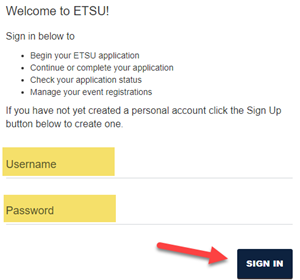
Step 2: Sign In to the ETSU Application Portal and Start a New Application
-
Step 3: Complete the Application
Choose "Graduate," select your student type (domestic, international, global), then select "Masters" or "Doctorate," and then select your start term. Next, choose a major and complete the application. *Your application is not complete without requesting/submitting supporting documents (transcripts, test scores, etc.).


Cost
| TN Residents | *eRate | Out of State |
|---|---|---|
| $672 per credit hour | $835.50 per credit hour | $1,513 per credit hour |
| - The *eRate applies to students living out of state and taking all web-based courses. - Additional fees may be required. - Visit the Paying for College page to read more about costs and financial aid options. - The costs associated with attending ETSU can include both direct and indirect costs. Please review ETSU's Cost of Attendance for more details. |
||
Frequently Asked Questions
-
What accreditations apply to this program?
East Tennessee State University is accredited by the Southern Association of Colleges and Schools Commission on Colleges (SACSCOC) to award baccalaureate, master’s, education specialist, and doctoral degrees. East Tennessee State University also may offer credentials such as certificates and diplomas at approved degree levels. Questions about the accreditation of East Tennessee State University may be directed in writing to the Southern Association of Colleges and Schools Commission on Colleges at 1866 Southern Lane, Decatur, GA 30033-4097, by calling (404) 679-4500, or by using information available on SACSCOC's website (www.sacscoc.org).
-
Does a student's undergraduate degree have to be related to this field?
Students should have a bachelor’s degree in a geoscience, environmental health, public health, biology, or a related discipline.
-
Does this program require the GRE?
The GRE is not required for admission to the program.
-
Are the courses for this program asynchronous or synchronous?
The program is offered in on-ground and online asynchronous formats.
-
Are there any on-campus requirements?
For students in the online, non-thesis track, there are no on-campus requirements.
For students interested in the thesis track, please visit the in-person program page.
-
Does this program require a thesis, internship, or other culminating experience?
Yes. Online students enroll in the non-thesis track. This track requires an applied graduate experience through a capstone pathway. Students will choose one of the following courses:
- ENVH 5640 Environmental Risk Assessment
- GEOS 5910 Research in Geosciences
The non-thesis track may be completed either online or on ground.
The thesis track is designed for students seeking research-intensive training and faculty-mentored scholarship. The thesis track is offered on-campus only.
-
Is this program designed to meet the needs of adults who work full-time and/or have family obligations?
Yes, especially for students in the non-thesise track, which may be completed online. Online students will enroll part-time only, offering a great fit for working adults and others who need flexibility.
-
What is the time to completion?
Full-time students complete the degree within two academic years. The program operates as a cohort model.
Part-time enrollment in the program is permitted for online students only. Part-time enrollment in the program is permitted for online students only. Part-time students have
six academic years to complete the degree from their date of first enrollment. -
When can I start?
The application deadline is August 1 for the fall semester (August) and October 1 for the spring semester (January).
-
Are scholarships available?
Students are encouraged to visit the Paying for Graduate School website for information regarding financial resources.