History
History of the Army ROTC Program
The story of the Reserve Officer Training Corps (ROTC) is a long journey. One that defines the American "citizen-soldier" a unique figure in world history. A leader that is capable of thriving in both civilian careers and military leadership.
The Birth of an Idea
The story begins in 1819 with Captain Alden Partridge, a former West Point superintendent who envisioned a new kind of education. At his academy in Vermont (now Norwich University), Partridge pioneered a system where young men could undergo rigorous military training while pursuing civilian higher education. His vision was simple yet profound, the nation would gain a ready pool of trained leaders for times of crisis, but during peacetime, these men would remain free to build communities and businesses. By the mid-1800s, this "citizen-soldier" model spread to institutions like the Virginia Military Institute, The Citadel, and other major state universities.This concept of leadership training went national with the Land Grant Act of 1862. Under its terms, each state received 30,000 acres of public land to establish institutions of scientific learning. In return, these land grant colleges were to offer military tactics courses. Graduates of these institutions, along with those trained on other campuses, would ultimately fight in both the Union and Confederate armies during the Civil War.
World Wars and the Birth of Modern ROTC
By the early 20th century, a total of 105 colleges offered military instruction. But as Europe dissolved into the chaos of World War I, it became clear that the standing U.S. Army was far too small to be effective if the country was drawn into the war. In response, patriotic citizens launched the Plattsburg Movement in 1915, creating summer camps to rapidly train civilian volunteers as officers. This momentum culminated in the National Defense Act of 1916, which formally established the modern college-based Army ROTC.It was while the program was still in its infancy that the U.S. entered World War I. However, the Army ROTC programs would only produce 133 officers by 1920. Yet, the ROTC program proved its worth during the "lean years" of isolationism that followed. When World War II erupted in 1941, it was the steady stream of ROTC-trained reserve officers who filled the ranks and lead the greatest generation in pushing back the Japanese Empire and crushing the Third Reich. Through their performance the nation’s ROTC programs earned the deep gratitude of Chief of Staff Gen. George C. Marshall, who noted that mobilization would have faced devastating delays without them.
Turbulence, Transformation, and Triumph
The Cold War and the Korean War reemphasized the importance of the role that the ROTC program played in the US Army. The Army could not afford to repeat the “lean years” that followed WWI. The ROTC Vitalization Act of 1964 transformed the program into the military’s primary source of active-duty officers, introducing scholarships and stipends in order to attract talented future leaders. However, the program soon faced its greatest trial during the Vietnam War. Campus protests and the end of the draft in 1973 caused enrollment to plummet. To survive, the ROTC adapted. In the 1972–73 school year, a successful pilot program opened ROTC doors to women, permanently changing the face of military leadership.In 1986, the program entered its modern era with the creation of Cadet Command, which centralized and standardized officer training across 300 hundred colleges and the JROTC programs of over 800 high schools. Today, the legacy of the citizen-soldier lives on. Embodied by legendary leaders like Gen. Colin Powell, ROTC continues to prove the academic idealism and military discipline that makes up the Officer Corps of the United States Army.
Buc Battalion History
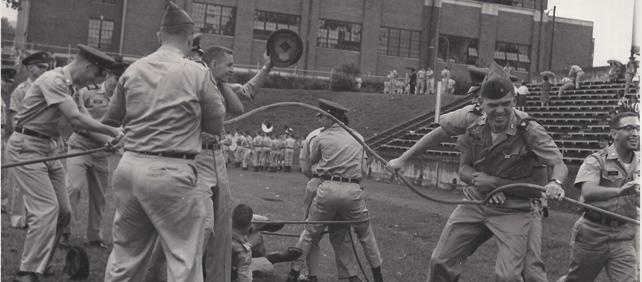
The Reserve Officers' Training Corps was established by the National Defense Act of 1916 to train men on college campuses for commissioning. However, the campaign to establish a Senior ROTC detachment at East Tennessee State College was by no means an easy task. In early 1950, University President Dr. C. C. Sherrod was invited by the Commanding General of Third Army to attend a regional ROTC conference at Georgia Tech, to address ROTC within the schools that made up the Tennessee College Association.
With the outbreak of the Korean War, the Georgia Tech conference was cancelled. Dr. Burgin Dossett, however, who had succeeded Dr. Sherrod as ETSC's president, immediately began a personal quest to establish a ROTC unit at East Tennessee State College. Dr. Dossett wrote to Colonel W. I. Sherwood, Chief of the Tennessee Military District, explaining that the facilities at East Tennessee State College were indeed adequate to accommodate a ROTC department. Following a favorable inspection, four Tennessee schools were recommended for consideration: Memphis State Teachers College, Vanderbilt University, Austin Peay College, and East Tennessee State College.
In November 1950, Dossett received a letter from the Commanding General of the Third Army requesting that East Tennessee State College formally apply for a Senior ROTC unit. Unfortunately, when the board met two months later, East Tennessee State College was not one of the 36 schools selected from the 275 applicants.
In February 1951, Dossett applied for an Air Force ROTC unit but was again turned down. However, Dr. Dossett refused to give up. One year later, after a second application to Third Army, an Army ROTC unit was assigned to East Tennessee State College on May 12, 1952. The program was made mandatory for all physically qualified male freshmen.
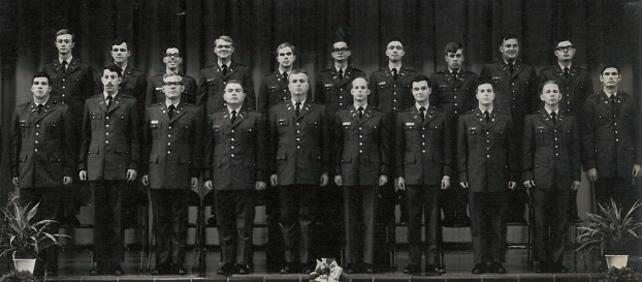
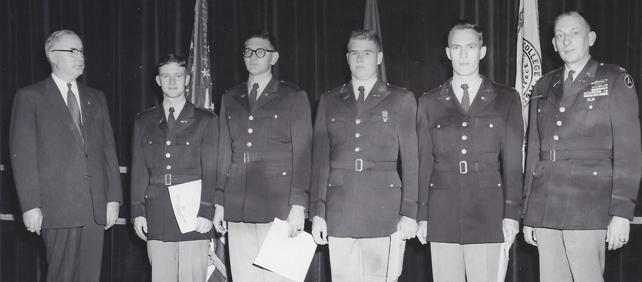
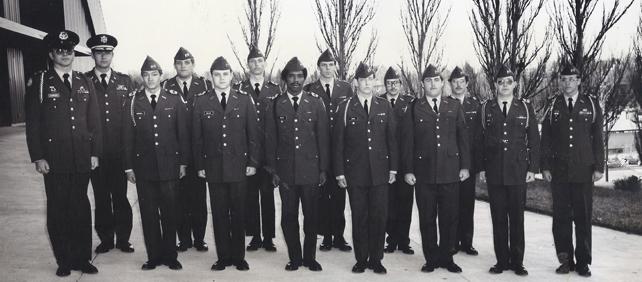
In 1953, East Tennessee State College held its first commissioning ceremony. Since that time, ETSU ROTC has commissioned over 1,600 men and women as U.S. Army Second Lieutenants. These great Americans have served our nation well, and are a testament to the consistently outstanding ROTC program here at ETSU.
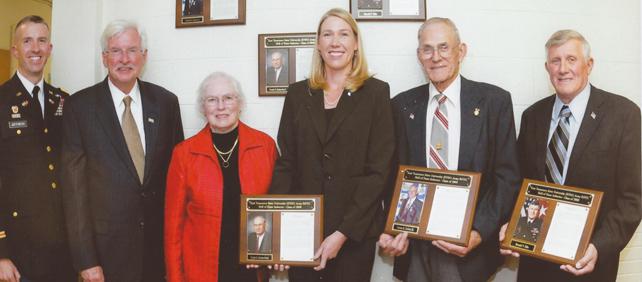
To date, 14 of these commissionees have achieved the rank of General Officer:
- Brigadier General James Burk '95
- Major General J. Edward Cassity (USMC) '57
- Lieutenant General Fred McCorkle (USMC) '99
- Major General Rondal Smith (USAF) '66
- Rear Admiral Frank Anderson (Navy) '50
- Rear Admiral Richard Chambers (Navy) '56
- Rear Admiral William Schmidt (Navy) '68
Deceased General Officers:
- BG Hickman
- BG Stalcup
- MG Brooks
- MG Crumley
- MG Harrell
- RA Anderson
- RA Chambers
A number of other ETSU ROTC alumni have given their lives while serving in the United States Army on active duty. Nine of these alumni died in the Vietnam Conflict, one during Desert Storm.
- Captain Alvin K. Broyles, 28 April 1965
- Captain Donald J. Fillers, 28 May 1965
- Captain Eugene D. Franklin, 24 June 1965
- Major Billy J. Nave, 27 June 1966
- First Lieutenant Douglas L. Jones, 12 October 1966
- Captain Gordon O. Walsh, 16 April 1967
- First Lieutenant Daniel L. Mullins, 31 August 1967
- Captain James E. Reed, 1 February 1968
- First Lieutenant James D. Dugger, 16 October 1972
- Captain Daniel E. Graybeal, 27 February 1991
Over the last seven decades, ROTC at ETSU has produced consistently outstanding young officers, while changing with the times to remain current. In 1953, the Sponsor Corps was formed to enable females to be a part of the ROTC program. Eleven years later, in 1964, Military Science became an approved minor. During the turbulent 70's, following significant protests on campus, the administration made ROTC a voluntary program. This last change mirrored the Army's move to an all-volunteer force, and while the size of the program decreased, the quality of the Cadet corps has remained high.
Today's Cadets are actively involved in numerous ROTC and other campus organizations, including the Pershing Rifles drill and ceremony team, Scabbard and Blade national honor society, Presidents Pride, the ETSU ROTC running club, and the Eddie Reed Ranger Company. Established in the early 1970s, the Ranger Company continues to train Cadets on advanced techniques beyond the standard Military Science curriculum; team members also represent ETSU at various regional Ranger Challenge competitions. Our Rangers have developed a reputation for displaying exceptional professionalism, dedication to excellence and the desire to lead by example.
As we look back over the past 70-plus years, ETSU's Army ROTC program has not only been a source of outstanding officers for the United States Army, but a highly successful academic department within the College of Business and Technology, and a valuable contributor to ETSU and the local community. Today's Battalion Cadets continue to train and prepare for challenging careers in the service of our Nation, while the skills they develop in ROTC allow our alumni to be successful as Army officers and civilian leaders. Building on a strong tradition of excellence and continued growth in Cadet numbers, the future looks bright for ETSU Army ROTC.