You are on your emergency room rotation in the month of April and are asked to examine
a previously healthy 35-year-old man who presents with a three-day history of fever,
headache, fatigue, myalgias, nausea, and a non-productive cough. He has been hiking
the Appalachian Trail for the past three weeks.
Physical examination reveals an oral temperature of 38°C, a pulse rate of 92 beats
per minute, a respiratory rate of 10 breaths per minute, and a blood pressure of 122/85
mm Hg. A faint erythematous rash is visible on his trunk and proximal extremities.
The examination is otherwise within normal limits.
Laboratory findings are notable for the findings of leukopenia, throbocytopenia, hyponatremia,
and elevated levels of AST, ALT, LDH, and CRP. His chest x-ray and EKG are normal.
What is your diagnosis, what test(s) would you order to confirm your suspicions, and
what treatment, if any, do you recommend?
DIAGNOSIS: Monocytic Ehrlichiosis. Ehrlichia chaffeensis is a Gram-negative, obligate intracellular
bacterium that causes Human Monocytic Ehrlichiosis (see image below). The organism
is transmitted by the bite of the lone star tick (amblyomma americanum) and can cause illness ranging from a mild flu-like illness to severe, life-threatening
disease. Epidemiology:The disease is extant in the southeastern, south-central, and mid-atalantic United
States with the highest incidence in Arkansas, Missouri, Oklahoma, Tennessee, and
North Carolina. It has a peak incidence in the Spring and Summer months - corresponding
with tick activity. Mammals (including white-tailed deer and dogs) serve as the reservoirs
of the organism.
Clinical Manifestations: Following an incubation period of 10-14 days, the patient develops a flu-like illness
with fever, rigors, headache, fatigue, myalgias, GI symptoms (nausea, vomiting, and/or
diarrhea), and, sometimes, an erythematous rash. Symptoms and signs of an encephalitis
may also develop.
Laboratory findings: These may include leukopenia, thrombocytopenia, elevated liver enzymes, hyponatremia,
elevated LDH and CRP levels, and anemia. A Wright-Giemsa blood stain should be searched
for the presence of intramonocytic or intragranulocytic ehrlichia (see below).
Treatment: Doxycycline 100 mg po or iv twice daily for 7-10 days (continue for 3 days after defervescence).
Start empiric treatment immediately if the diagnosis is suspected. Do not wait for
laboratory confirmation.
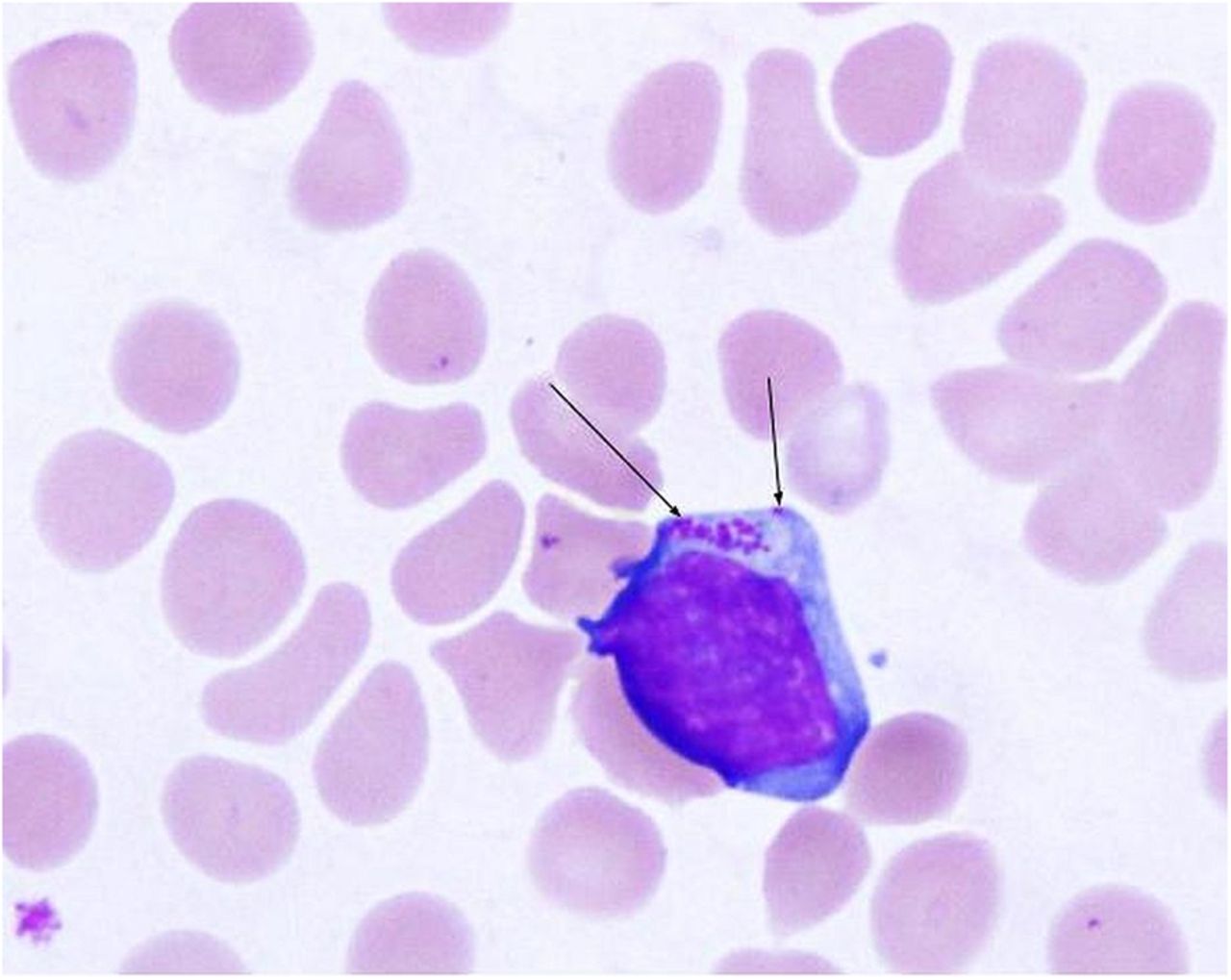
The arrows identify multiple intracellular Ehrlichia chaffeensis bacteria