America's Best Award - 2015
U.S. News & World Reports have released their annual high school rankings. University School received the ‘Silver’
medal award and was ranked 6th in Tennessee.
Message from Director,
I would ask you to read the front page of the May 13 Johnson City Press. University High is recognized as the 6thranked high school in the state, the 2nd ranked non-magnet high school in the state, and in the top 5% of all high schools
in the country. Those are outstanding achievements that are the result of the hard work done by all
faculty, staff, support persons, students and parents. The high school faculty takes
center stage much like the K-8 faculty did several weeks ago when we were the number
1 ranked K-8 school in the region. This goes to show we are dependent on one another
and when we work together we do great things for children which is what a school is
all about. I am proud of each and every one of you and I ask that you share this with
the students who made this happen. These awards validate the work we do each and every
day. Thank you for all you do.
University School ranked among top 10 schools in state
May 13th, 2015 2:22 pm by Rick Wagner, NET News Service
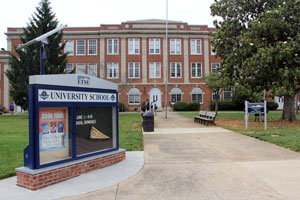 University School in Johnson City and Dobyns-Bennett High School in Kingsport were
ranked sixth and seventh, respectively, in Tennessee by a U.S. News & World 2015 report
released Tuesday.The magazine's annual high school rankings also placed two Knox County
high schools and Morristown West high up on the Tennessee high school education totem
pole. They were among 16 Tennessee schools recognized as being in the top 5 percent
in the nation. No schools among 52 Virginia high schools that made the top 5 percent
ranking nationwide were from Southwest Virginia.D-B ranked third statewide in non-magnet
schools, just behind Farragut in Knox County and University School, which is on the
East Tennessee State University campus and officially part of the Washington County
school system.
University School in Johnson City and Dobyns-Bennett High School in Kingsport were
ranked sixth and seventh, respectively, in Tennessee by a U.S. News & World 2015 report
released Tuesday.The magazine's annual high school rankings also placed two Knox County
high schools and Morristown West high up on the Tennessee high school education totem
pole. They were among 16 Tennessee schools recognized as being in the top 5 percent
in the nation. No schools among 52 Virginia high schools that made the top 5 percent
ranking nationwide were from Southwest Virginia.D-B ranked third statewide in non-magnet
schools, just behind Farragut in Knox County and University School, which is on the
East Tennessee State University campus and officially part of the Washington County
school system.
© 2015 Johnson City Press
Magazine: University High among state's best No. 6, to be exact, according to U.S. News & World Report, and No. 2 non-magnet school
BY RICK WAGNER
NET News Service
U.S. News & World Report has high praise for University School.The Johnson City school was ranked No. 6 among Tennessee's high schools by the magazine's 2015 rankings, released Tuesday.Kingsport's Dobyns-Bennett High School was ranked seventh in the state.The magazine's annual high school rankings also placed two Knox County high schools and Morristown West high up on the Tennessee high school education totem pole. They were among 16 Tennessee schools recognized as being in the top 5 percent in the nation.University School, on the East Tennessee State University campus and officially part of the Washington County School System, ranked second among the state's non-magnet schools. D-B ranked third statewide in nonmagnet schools, just behind Farragut in Knox County University School .The complete listing of Tennessee high schools ranked and rated by the magazine is at http://www.usnews.com/education/best-high-schools/tennessee?int=9abb08 According to the magazine's website, the magazine did the 2015 Best High Schools rankings with RTI International, a North Carolina-based research firm.It said high schools were evaluated in three stages:• "First, U.S. News looked at overall student performance on state-required tests. Schools had to perform better than average to pass, but because of a slight change to the methodology this year, more schools qualified for the rankings.• "Then, U.S. News factored in how effectively schools educated their least-advantaged students — those of black, Hispanic and low-income backgrounds.• "Finally, schools were assessed on how well they prepared students for college based on participation in and performance on Advanced Placement and International Baccalaureate exams."University School got a 1,188th national ranking — along with the sixth ranking statewide and second ranking among non-magnet schools."We're very proud of that school," Washington County Assistant Director of Schools William Flanary said. "They are chronic overachievers." Flanary said he is impressed with how students there earn college credit while still in high school, a trend area school systems and the state are pushing.University School had a student-teacher ratio of 16:1, a college readiness score of 36.2, an algebra proficiency score of 3.3 and an English proficiency score of 3.2.Both D-B and University School got a silver-level award from the magazine on a scale of gold, silver and bronze. Morristown West ranked 10th in the state and fifth among non-magnet schools.Hume-Fogg Academic High School in Nashville ranked as the top high school in the state and 48th nationally.
© 2015 Johnson City Press
Methodology used for How U.S. News Calculated the 2015 Best High Schools Rankings :To produce the 2015 Best High Schools rankings, U.S. News & World Report teamed with North Carolina-based RTI International, a global nonprofit social science research firm.RTI implemented the U.S. News comprehensive rankings methodology, which is based on these key principles: that a great high school must serve all of its students well, not just those who are college bound, and that it must be able to produce measurable academic outcomes to show it is successfully educating its student body across a range of performance indicators.We started by reviewing 29,070 public high schools in all 50 states and the District of Columbia. Some of those schools had to be eliminated from consideration, mainly because they were too small to be analyzed. This reduced the count to 19,753, which is the total number of public high schools across the country that had high enough 12th-grade enrollment and/or sufficient enrollment in other grades during the 2012-13 school year to be eligible for the rankings. National RankingsA three-step process determined the Best High Schools. The first two steps ensured that the schools serve all of their students well, using their performance on the math and reading parts of their state proficiency tests as the benchmarks. For those schools that made it past the first two steps, a third step assessed the degree to which schools prepare students for college-level work.
- Step 1: The first step determined whether each school's students were performing better than
statistically expected for students in their state.
We started by looking at reading and math results for all students on each state's high school proficiency tests. We then factored in the percentages of economically disadvantaged students – who tend to score lower – enrolled at the schools to identify schools performing much better than statistical expectations.
U.S. News made one important methodology change to Step 1 in the 2015 rankings compared with previous editions of the rankings. We lowered the performance threshold necessary for a school to pass Step 1. To qualify for the rankings published from 2012 to 2014, schools had to meet a performance threshold of one-half of one standard deviation above the average. For this year's rankings, schools only had to reach one-third of one standard deviation above the average.
This slightly lower threshold was applied to a school's performance compared with what would be statistically expected for that school, based on its percentage of economically disadvantaged students. The change meant that a larger percentage of high schools passed Step 1 in 2015 than in last year's rankings, and it resulted in hundreds more high schools winning medals. In the 2015 rankings, approximately one-third of eligible high schools earned a medal, compared with around one-fourth of those eligible in 2014.
Even with the lower threshold, schools still had to perform better than average to win a medal. One key reason for implementing this change is to reduce year-to-year volatility in the rankings, so fewer high-performing schools drop out of the rankings over small changes in their performance on state assessments. - Step 2: For schools passing this first step, the second step assessed whether their disadvantaged
students – black, Hispanic and low-income – were outperforming disadvantaged students
in the state.
We compared each school's math and reading proficiency rates for disadvantaged students with the statewide results for these student groups and then selected schools that were performing better than their state averages. - Step 3: Schools that made it through the first two steps became eligible to be judged nationally on the final step – college-readiness performance – using Advanced Placement or International Baccalaureate test data as the benchmarks for success, depending on which program was largest at the school. Click to continue reading methodology.........
University School’s profile consisted of Academic Indicators, Test Scores, Rankings/Awards, Teacher-Student ratio, as well as additional School data.